

Yesterday we inaugurated the intricate fascinations of Stereophonic Sound. Today, we pick up where we left off and continue with RCA Victor’s detailed explanation of the technical differences between recording a monaural record with that of the stereophonic record. So, without further ado, I present part 2 (out of 3) of RCA Victor’s What is Stereophonic Sound?

Presented by RCA Victor
Let’s compare hearing to seeing for a moment. You see images on your left with your left eye, images on the right with your right eye. Yet, because your brain can do two jobs at one, you get a total unified picture in its true perspective.
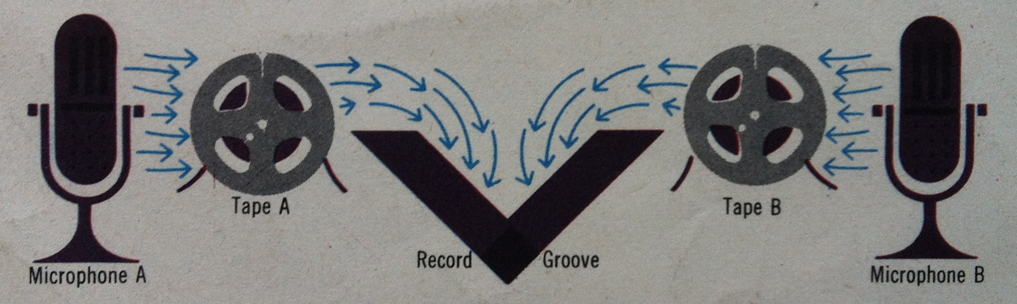
Stereo sound is simply the attempt to give you music as it is heard by both ears. Essentially, what happens is that two microphones, left and right, pick up what goes on in the orchestra at the recording session. These two microphones feed the musical impulses to two soundtracks on tape. The two soundtracks are then pressed into the grooves on a stereo record.
The sound from a record partly depends upon how the needle moves or vibrates. For example, when Edison designed his phonograph to play cylindrical records, he made the needle vibrate up and down. This is called the “hill and dale” system, or vertical cutting.
On a conventional, monaural record, however, the needle moves from side to side, or laterally. The lateral movement has been used ever since the flat record replaced Edison’s cylinder.
What about the stereo record? Each groove on a stereo record has two soundtracks cut into it, and they are cut into it both laterally and vertically. In order to pick up the two soundtracks, a stereo needle capable of moving complexly has been developed; it vibrates both laterally and up and down. Simultaneously, the lateral movement picks up one channel of recorded sound, the vertical movement the other.
 The Prudent Groove