Empire Jazz – Produced and Arranged by Ron Carter

empire-jazz-coverThe Galactic Empire, and all its personnel, get the dive-bar treatment in this junk induced, vodka-and-coke-spilling, dank, eye-burning, smoke-filled classic for the casual 1980 Contemporary Jazz fan in all of us. The very phrase “Contemporary Jazz” still freaks me out.

While listening to this record, I imagine myself sitting at Croce’s restaurant in San Diego, drinking a blue milk cocktail (a DOUBLE, why not?) while trying to make casual conversation with the person next to me, who is too busy scanning the room for someone more interesting to talk with. Very put together, and a bit too structured for my taste, Ron Carter and his (at that time) modern version of Figrin D’an and the Modal Nodes use this album more as a vehicle to display their various talents (of which this album has many), rather than a stage in which to proclaim their love for Star Wars themed music. 90% straight-edge Contemporary Jazz and 10% Star Wars, Empire Jazz lacks the campy, not-taking-itself-too-seriously, classic lounge vibe that the Evil Genius Orchestra delivered in 1999’s Cocktails in the Cantina (AllMusic.com Review). It’s Contemporary Jazz all right, but this album misses the mark set by Meco in his 1977 classic, Star Wars and Other Galactic Funk; An album I misguidedly attributed Empire Jazz to mirror.

End of side 1

empire-jazz-backRSO (Robert Stigwood Organisation) released this album in an attempt to appeal to the adult Star Wars fan, or so I gather. Empire Jazz, also known as RS-1-3085 is “also available in 8 track 8T-1-3085 and cassette CT-1-3085.” Too bad they couldn’t have worked TK-421 into their cataloging system, which would have been fun… a bit more fun than this album, I’m afraid.

The cover is, quite simply put, absolutely hilarious. It depicts Chewbacca doing his Thelonious Monk impersonation on the keys; C-3P0 working his well oiled, droid digits on the upright; R2-D2 using his electronic tentacles on the skins, which I buy, by the way; (I imagine R2 could rival Buddy Rich, if he’d ever lower himself to a challenge… R2, that is). And okay, I understand the idea of incorporating the “Empire” on the cover of an album called Empire Jazz, but on sax is a Stormtrooper… not too outlandish a notion, but I’d imagine it to be difficult playing a reed instrument WHILE WEARING A HELMET! And if that isn’t enough, the Sith Lord himself, Darth freakin’ Vader sits at an otherwise empty table with hands crossed, seemingly enthralled that a Wookiee had the patience to learn to play the piano.

Now, don’t get me wrong, Ronald Levin Carter has got talent. I mean, the man played with Miles Davis for crying out loud. It’s a finely executed album, just not exactly as kitschy as the cover suggests.

Current market value (as I type this) ranges from $2.94 in VG condition to $10.00 in NM condition (For Sale Here).

If you dig the Contemporary Jazz thing, consider this album. If you’re looking for Meco 2.0, you’re going to be disappointed.

 End of side 2
Jerry Lee Lewis vs. The Pirates

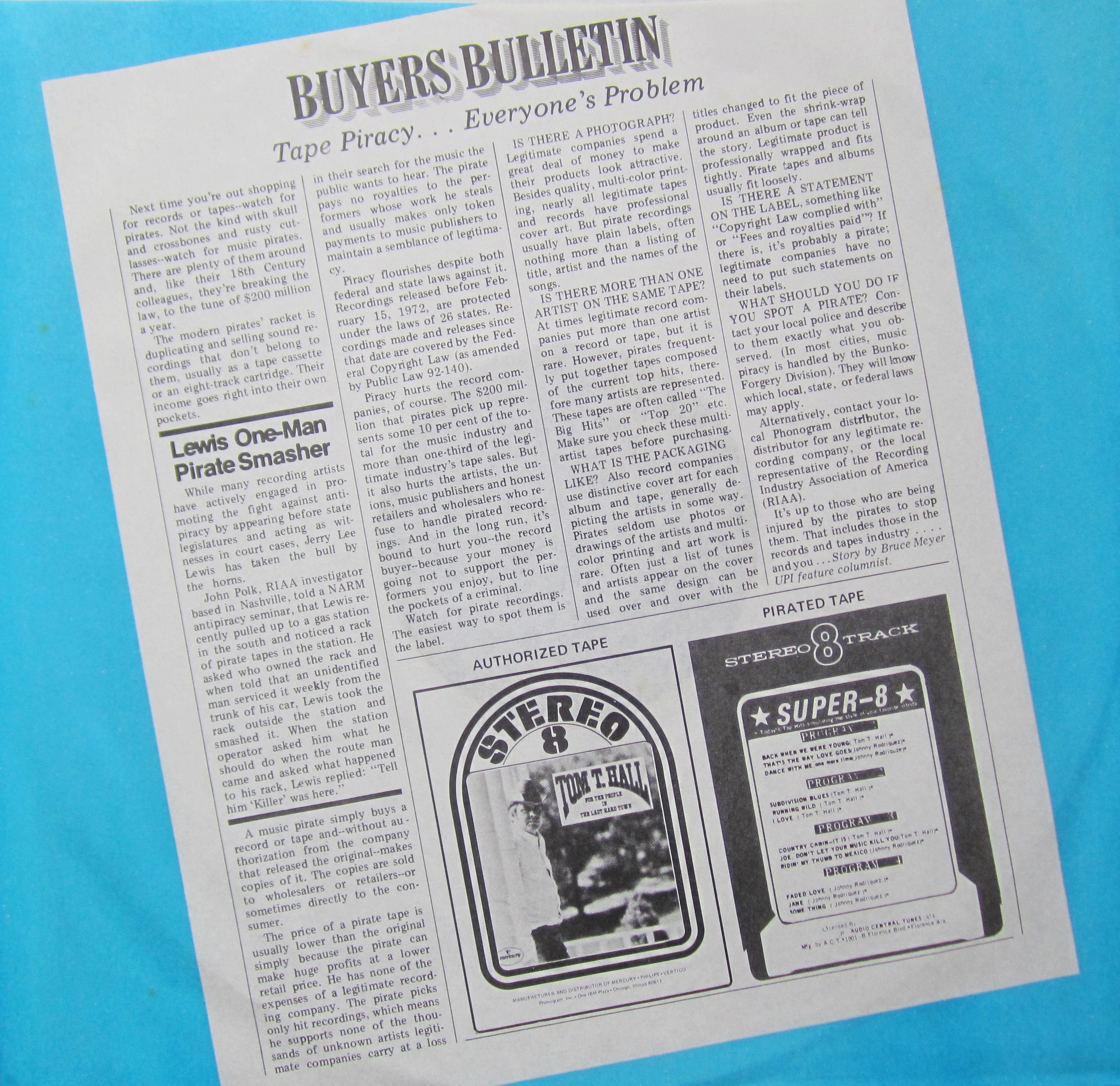
Anti-Piracy InsertI found this sleeve insert hiding inside a 1976 Mercury Records release of a Statler Brothers album. The story strives to inform the record owner of the hundreds of millions of dollars lost to 8-Track pirates. Bruce Meyer, who was apparently a UPI feature columnist, writes the story that still seems relevant some nearly four decades later. Jerry Lee Lewis makes a cameo.

Here is the story for your reading pleasure:

Buyers Bulletin

Tape Piracy… Everyone’s Problem

            Next time you’re out shopping for records or tape—watch for pirates. Not the kind with skull and crossbones and rusty cutlasses—watch for music pirates. There are plenty of them around and, like their 18th Century colleagues, they’re breaking the law, to the tune of $200 million a year.

The modern pirates’ racket is duplicating and selling sound recordings that don’t belong to them, usually as a tape cassette or an eight-track cartridge. Their income goes right into their own pockets.

_______________________________________________________________________________________

Lewis One-Man Pirate Smasher

While many recording artists have actively engaged in promoting the fight against antipiracy by appearing before state legislatures and acting as witnesses in court cases, Jerry Lee Lewis has taken the bull by the horns.

John Polk, RIAA investigator based in Nashville, told a NARM antipiracy seminar, that Lewis recently pulled up to a gas station in the south and noticed a rack of pirate tapes in the station. He asked who owned the rack and when told that an unidentified man serviced it weekly from the truck of his car, Lewis took the rack outside the station and smashed it. When the station operator asked him what he should do when the route man came and asked what happened to his rack, Lewis replied: “Tell him ‘Killer’ was here.”

_______________________________________________________________________________________

A music pirate simply buys a record or tape and—without authorization from the company that released the original—makes copies of it. The copies are sold to wholesalers or retailers—or sometimes directly to the consumer.

The price of a pirate tape is usually lower than the original simply because the pirate can make huge profits at a lower retail price. He has none of the expenses of a legitimate recording company. The pirate picks only hit recordings, which means he supports none of the thousands of unknown artists legitimate companies carry at a loss in their search for the music the public wants to hear. The pirate pays no royalties to the performers whose work he steals and usually makes only token payments to music publishers to maintain a semblance of legitimacy.

Piracy flourished despite both federal and state laws against it. Recordings released before February 15, 1972, are protected under the laws of 26 states. Recordings made and releases since that date are covered by the Federal Copyright Law (as amended by Public Law 92-140).

Piracy hurts the record companies, of course. The $200 million that pirates pick up represents some 10 per cent of the total for the music industry and more than one-third of the legitimate industry’s tape sales. But it also hurts the artists, the unions, music publishers and honest retailers and wholesalers who refuse to handle pirated recordings. And in the long run, it’s bound to hurt you—the record buyer—because your money is going not to support the performers you enjoy, but to line the pockets of a criminal.

Watch for pirate recordings. The easiest way to spot them is the label.

IS THERE A PHOTOGRAPH?

Legitimate companies spend a great deal of money to make their products look attractive. Besides quality, multi-color printing, nearly all legitimate tapes and records have professional cover art. But pirate recordings usually have plain labels, often nothing more than a listing of title, artist and the names of the songs.

IS THERE MORE THAN ONE ARTIST ON THE SAME TAPE?

At times legitimate record companies put more than one artist on a record or tape, but it is rare. However, pirates frequently put together tapes composed of the current top hits, therefore many artists are represented. These tapes are often called “The Big Hits” or “Top 20” etc. Make sure you check these multi-artist tapes before purchasing.

WHAT IS THE PACKAGING LIKE?

Also record companies use distinctive cover art for each album and tape, generally depicting the artists in some way. Pirates seldom use photos or drawings of the artists and multicolor printing and art work is rare. Often just a list of tunes and artists appear on the cover and the same design can be used over and over with the titles changed to fit the piece of product. Even the shrink-wrap around an album or tape can tell the story. Legitimate product is professionally wrapped and fits tightly. Pirate tapes and albums usually fit loosely.

IS THERE A STATEMENT ON THE LABEL, something like “Copyright Law complied with” or “Fees and royalties paid”? If there is, it’s probably a pirate; legitimate companies have no need to put such statements on their labels.

WHAT SHOULD YOU DO IF YOU SPOT A PIRATE?

Contact your local police and describe to them exactly what you observed. (In most cities, music piracy is handles by the Bunko-Forgery Division). They will know which local, state, or federal laws may apply.

Alternatively, contact your local Phonogram distributor, the distributor for any legitimate recording company, or the local representative of the Recordings Industry Association of America (RIAA).

It’s up to those who are being injured by the pirates to stop them. That includes those in the records and tapes industry…. and you…

Story by Bruce Meyer UPI feature columnist.

8-tracks

So, Jerry Lee Lewis smashed a rack of 8-Track tapes. Ok, but who had to clean it up?