
 Think you can speak confidently about the intricate details of stereophonic sound? Think you’ve licked the volatile, short-lived, simultaneous ear experience? Over the next three days, The Prudent Groove will leisurely lift the contents of one coveted RCA Victor insert explaining, in intimate detail, exactly, What is STEREOPHONIC SOUND? The following is presented, without esteemed interruption, by The Prudent Groove. Part 2 will follow tomorrow. I’ll be completely honest and admit that I learned more than I thought I needed while transcribing this informative insert. Maybe RCA Victor was onto something.
 Presented by RCA Victor
Stereophonic sound on records is finally here. It will be widely discussed, widely written about, and, perhaps, widely misunderstood. It cannot help but be; it is a complex achievement as well as an extraordinary one. We offer the following primer on the subject with the hope that it will both help you in understanding how and why stereo works and enhance the hours of listening pleasure stereo will offer in your home.
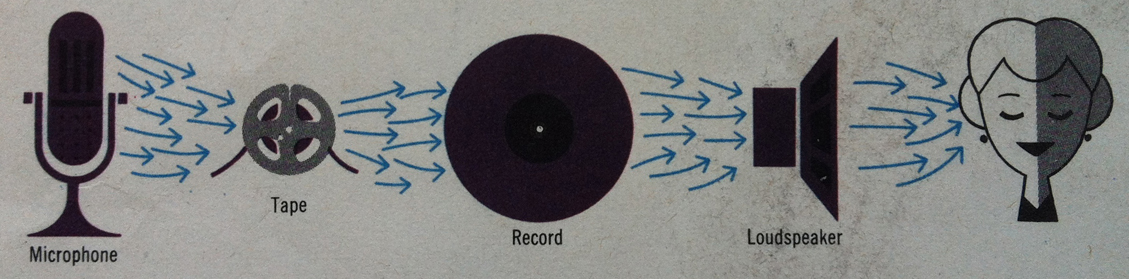
Before stereo recording techniques were developed, the impulses of music were picked up by only one microphone. These impulses were then fed to one tape and from there to the conventional, monaural record, which you heard in your living-room through one loudspeaker. The conventional record offered brilliant sound and exciting sound, but, of necessity, it also offered only one-dimensional sound.
 Now, the simple and obvious fact remains that we all have two ears, and we are used to hearing things dimensionally. Generally speaking, your left ear has a tendency to hear what goes on in the left side of a room, your right ear, what goes on in the right side of the room. Your brain then does two jobs. It combines both the impression received by the left ear and that received by the right ear into one total impression which we call music. At the same time, it retains the spatial or dimensional impression, music to the left and music to the right.
 The Prudent Groove
Music to the left of me, music to the right, here I am…