A Subtle Trip Down Nostalgia Ave

Root DownThrough rose-colored ear goggles, 1995 was a fantastic year. In the throes of high school juvenility, I found repeated comfort in the hunting and gathering of rare and out of print Beastie Boys singles and EPs. Although manly on compact disc at the time, I was able to nab a few 12” singles that, for years, would act as the crowning pillars of my now, nearly completed, Beastie Boys discography.

Beastie Boys TowerThe 1995 Root Down EP got heavy play in those days, and although it would take me well into the 2000s to track down this blue vinyl version, each transparent, cool spin brings with it aging thoughts and specificities of that fabled summer of 1995. Much has changed in the past 19 years (like it does), but it’s refreshing to travel down Nostalgia Ave from time to time, and for me, it’s important to recognize the vehicles that carry you back.

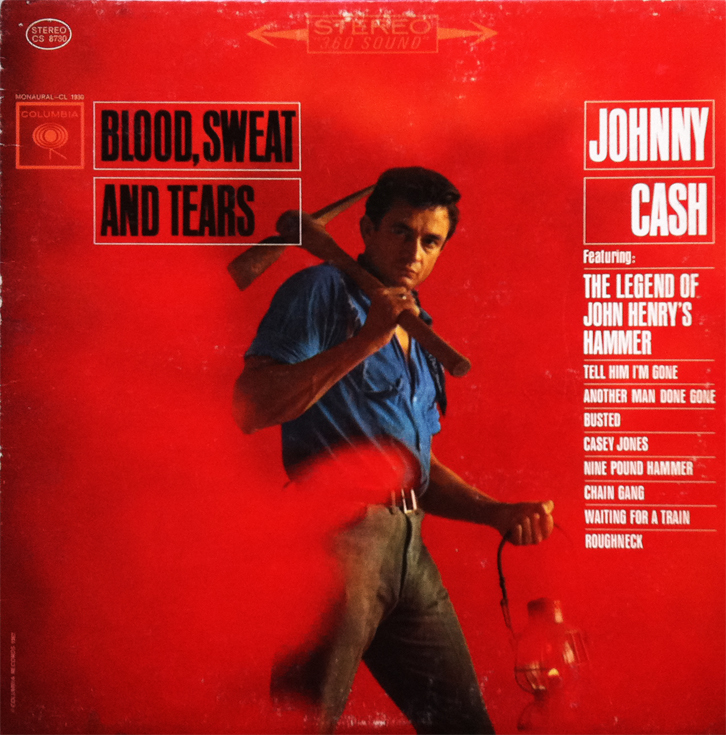
Blood, Sweat and Tears

BS+TWhenever I’m feeling nostalgic, I tend to turn to the roughneck, blue-collar grit of Johnny Cash. While I’ll prefer Mr. Cash’s work with the Tennessee Two during their Sun Records days, there was something about Blood, Sweat and Tears that stuck out like a rusty spike awaiting its inevitable drive into the cold, hard Earth that grabbed my sleep-clouded eyes this morning. Since it’s Monday morning for all of you hard working pencil pushers, the inevitable start to yet another inevitable workweek, Blood, Sweat and Tears seemed desperately appropriate.

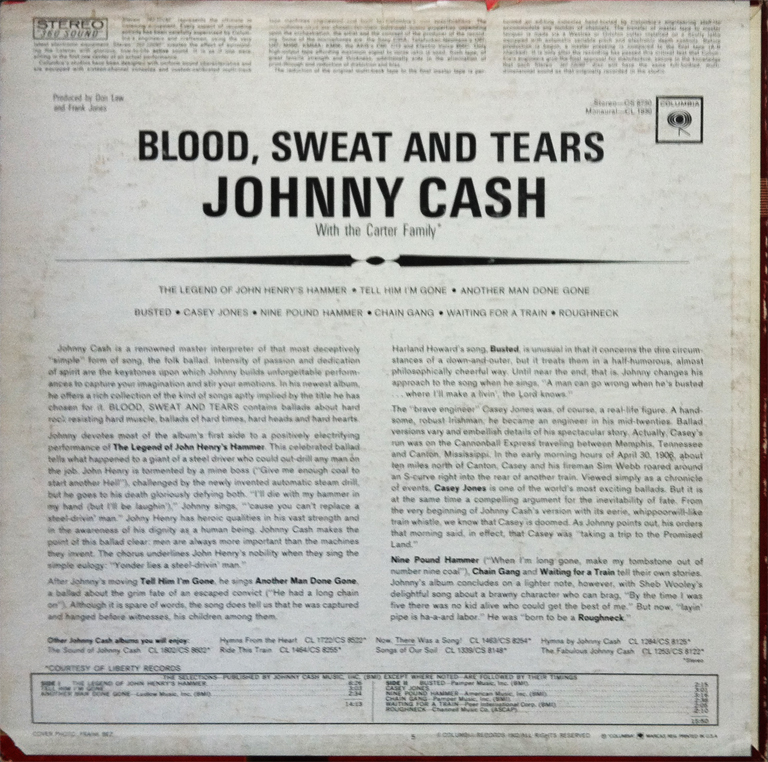
BS+T BackA collection of working man ballads, this, Mr. Cash’s 15th album, was released in 1963 on Columbia Records and features the soulful accompaniment of the Carter Family, the same legendary folk ensemble he’d become a part of some five years later, in March of ’68, when he married June Carter.

So, welcome to the working week, and if you find yourself daydreaming for an era without redundant meetings, corner-cutting executives, or inner-office politics, book some time with the musical spokesperson for the hardworking everyman, Mr. Johnny Cash.

Kaleidoscopic Wondersound

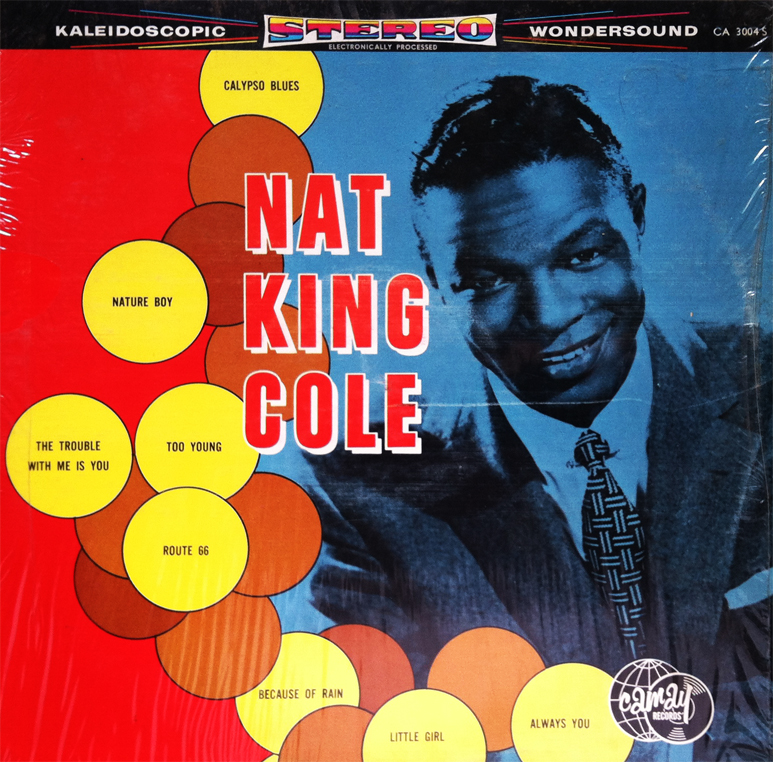
Golden HitsI’m as much a fan of Nat King Cole as the next chap, but I can’t for the life of me figure out the fine print to the back alley pact Mr. King Cole made with some powerful and fame-granting deity that would result in such a uniformly, and unmistakably grand record album experience, that it would warrant the need for such a marvelous, and attention grabbing phrase as, Kaleidoscopic Wondersound.

Let’s break this phrase down, shall we? Kaleidoscope is a defined by Merriam-Webster (http://www.merriam-webster.com) as:

: a tube that has mirrors and loose pieces of colored glass

or plastic inside at one end so that you see many different

patterns when you turn the tube while looking in through

the other end

: a changing pattern or scene

Kaleidoscopic WondersoundNow, I’m not sure this 1958 release on Camay Records, officially titled Nat King Cole’s Golden Hits, resembles anything tube-like, is made of any colored glass, nor is it in any way, shape, or form a conduit with which to change patterns or scenes. What do you think? Does its use carry with it any sort of validity? Ok, moving on…

Again with the help of our friends at Merriam-Webster (we’re not really friends), the word wonder is defined as:

: something or someone that is very surprising, beautiful,

amazing, etc.

: something that is surprising or hard to believe
Camay RecordsMr. King Cole is certainly a sharp dressed gentleman, but I certainly wouldn’t use the word beautiful to describe him. He is, however, somewhat amazing, something that isn’t necessarily “very surprising” or for that matter “hard to believe.”

Last but certainly not least we change pace a bit, and head to Dictionary.com for a breakdown of arguably the most important word in the phrase, sound:

: the sensation produced by stimulation of the organs of

hearing by vibrations transmitted through the air or other

medium.

So, to accurately and definitively explain the rhythmic impact of Nat King Cole’s Golden Hits, one, by definition, could describe it, and it’s implementation of Kaleidoscopic Wondersound, in any or all of the following three ways:

1. Organ stimulating pattern tubes of a surprising nature

2. Beautifully transmitted vibrations through colored glass

3. Sensational and stimulating surprises that change and has mirrors

Sounds logical to me! We hope you enjoyed your weekend and we thank you for making it through today’s nonsense (fyi, don’t look for any hidden meaning to today’s post… it isn’t there)!

What’chu talkin’ ‘bout, Willis?

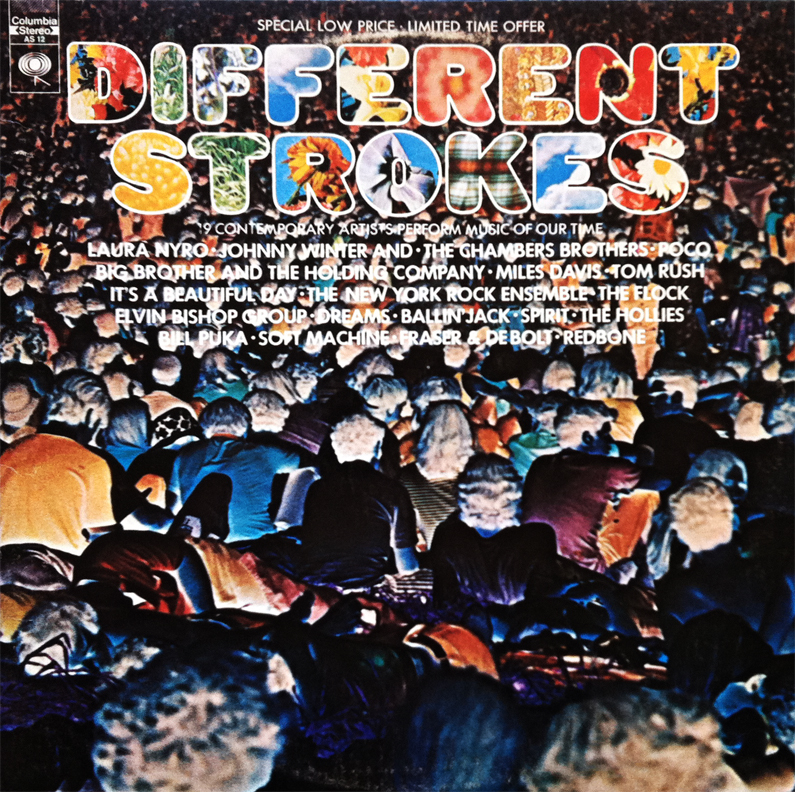
Strokes FrontI’m not entirely sure how different these strokes of “19 contemporary artists performing music of our time” were in 1971, but that doesn’t stop Columbia Records’ “special low price limited time offer” marketing ploy from capturing a wonderful, meshy, medley of jazz rock, southern fried rock, psych rock, sci-fi jazz, open field soul, and piano-friendly folk rock (and that’s just side A) on one, easy to access record.

Strokes BackDifferent Strokes launches with a bit of a gaffe as Johnny Winter And’s Rock and Roll, Hoochie Koo leads the pack of (somewhat) lesser known greats, but strategic placing of the needle can very easily, and wisely, turn this 19 track slab of delicately formed polyvinyl chloride into a 18 track time capsule representing the best Columbia Records had to offer in the burgeoning, wide-eyed, and fried-minded 1970s… but what the hell do I know? I wouldn’t have been born for another eight years.

Different Strokes is definitely worth seeking out if you don’t already own it, and can be had for exceptionally cheap if you’re so inclined. Coming highly recommended by the PG, Different Strokes is the perfect soundtrack to this, or any coffee-sipping, cloudless, southern California Saturday morning (my esteemed apologies to those residing in less than ideal climate conditions).

Burned for Better Playability

New MCDThe Murder City Devils, Washington state’s answer to the rum & coke-drinking, bar-closing delinquents of the early 21st century, have, for me, been labeled the garage rock grandfathers of my eclectic collection. Often inebriated, and always loud, the Murder City Devils ease the angry pain of worried, early mornings, and offer a welcoming, yet nagging soundtrack to the bitterness and uneven temperament of everyday life. (i.e. They’re good; you should check ‘em out!)

This 45, a split with Gluecifer, is uniquely discernible from any other release I’ve ever seen. As you can see, the bottom corner has been torched (not by me, although the picture suggests otherwise), which yes, is a rather over-simplified gimmick, but its design technique is both fitting, and particular to each (burned) release.

Happy Friday to those who have not yet lived it, and remember, whether you’re a resident of Murder City or not, the Devils are just a simple spin away.

The Blackouts During a Blackout

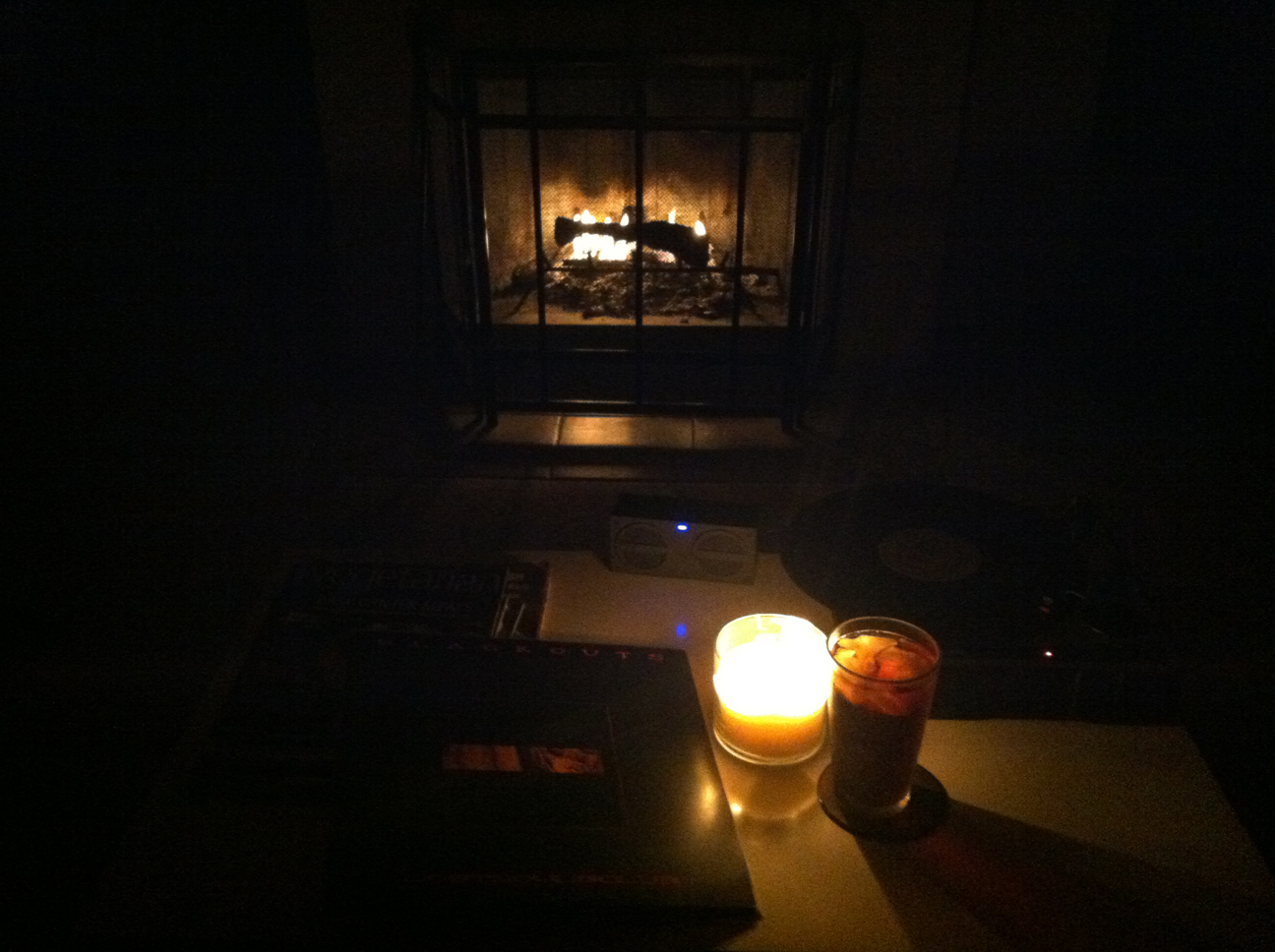
BlackoutsWhen the first one hit, I found myself amongst a cloud of darkness, and a kitchen full of dirty dishes. When the second one hit, I (literally) ran to the office for my portable, and this 1985 release (Wax Trax! Records cat. no. WAX006), Lost Soul’s Club by the Blackouts. I’ve lived in Southern California for over 10 years and have never experienced a blackout, so, quick on my feet, I wasn’t about to miss an opportunity (however brief), to enjoy the Blackouts during an actual blackout. Lucky for me (less so for my SO), this one lasted three hours.

I’m still working on an actual, respect-given write-up about my portable turntable setup (battery operated Numark PT-01 and iBN24 iHome rechargeable speaker, gifted by my thoughtful, music-loving parents), but I will say this: the ability to listen to records literally anywhere and at literally any time is a luxury I’m rapidly becoming accustomed to.Power Outage

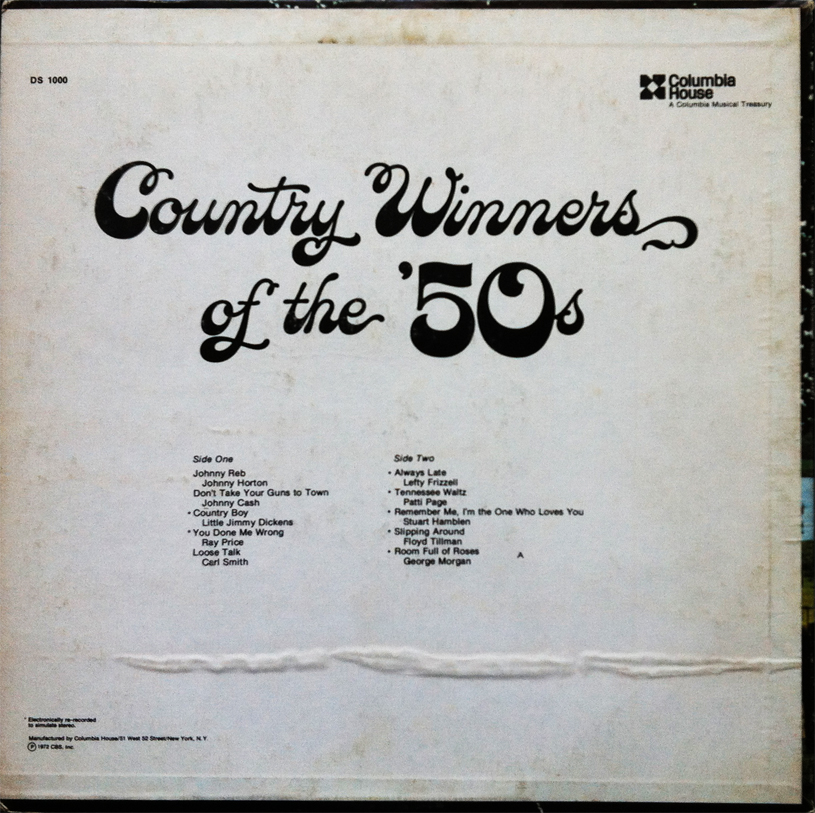
* Electronically Re-recorded to Simulate Stereo

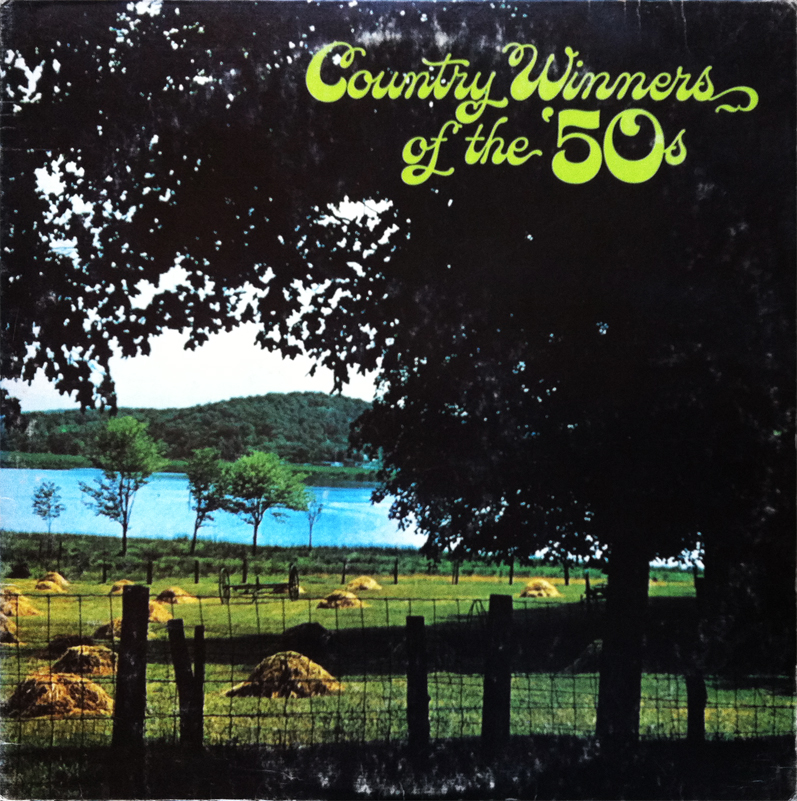
Country Winners1972’s Country Winners of the ‘50s is probably my earliest mail-order album offered from the minor-music-loving-money-snatchers, Columbia House. I have a rather unsettling confession to make. Back in Junior High, I was a member of Columbia House (as were the majority of my friends). Sure, I got suckered into 10 CDs for a penny, and nearly wept at the terribly overpriced, mediocre albums I was forced to purchase in order to round out my membership obligation. I believe Aerosmith got heavy play in those days… it was a dark time for sure.

Country Winners of the ‘50s is, in my opinion, a great representation of the “true” country sound. People scoff at my unashamed pride when I admit that I rather enjoy country and western music. What I (nearly always) need to explain is that I don’t listen to anything from either genre past 1980 (save for the Rick Rubin helmed American Recordings releases).

Winners BackI look at this album cover and fancy the idea of canoeing across the bright, blue lake with my SO, ingesting the open, crisp air and savoring the soft warbling of rural birds making their majestic flight from shore to muddy shore. I doubt I’ll ever leave Southern California, but I often long for the serenity of the simple, calming life I left behind.

Pass the Etch

Pass the EtchI’d seen etched records before… in a collection curated by a friend during my early days as an optimistic and fragile young collector. It blew my mind at the time (a lot did at 19), but other than a displayable novelty, I really didn’t see much of the point. That was until I stumbled across this etched Pass the Mic by the Beastie Boys.

I’ve been a Beasties fan since discovering a beat-up compact disc of Paul’s Boutique in the Junior High Tech Ed. wing at my local middle school. It was scratched to all hell, but for reasons that still keep me up at night, that damn disc played like a champ… fate, or high-end electronics of the compact disc playing nature in early 1992 deserves a lifetime of thanks.

Anywho, this is a single sided, etched UK 12” EP of general limited edition tendencies, and I’ll be damned if I know what the hell to do with it. I can’t for the life of me imagine any sort of framed display that would give this monster its deserving, mic passin’ respect… so, sandwiched between the Jimmy James and Gratitude singles it sits… longing for a better, more appreciated purpose.Bum

Don’t Miss the Train

Train in Vain18 tracks weren’t enough for the illustrious London Calling, the third studio album by the legendary misfits of genre-bending punks, The Clash. Unofficially hidden, or rather lopped on after the appropriate concluder Revolution Rock, the third and final single stemming forth from this prodigious album, Train in Vain (not unlike a retaliatory missile, or the first bullet fired during a revolutionary riot), was originally written and recorded as a giveaway track for the publication NME (or New Musical Express… I just found out), and was to be released as a flexi-disc single through the magazine… something that, for whatever reason, never came to be.

Certainly not news to the astute a-Clash-ionado, this little nugget of info explains why London Calling ends perfectly (with Revolution Rock), then spits out an unscheduled, and unwanted encore with Train in Vain. This is certainly not to say TiV is a song of lesser listening value, rather its inclusion on London Calling, or its position therein rustles the feathers of album perfection. Since London Calling is the closest thing to a perfect album as is (save maybe for Sgt. Pepper’s Lonely Hearts Club Band, This is Tim Hardin, The Shape of Punk to Come, Paul’s Boutique, Circa: Now!, The Kinks Are the Village Green Preservation Society, or Bizarre Ride II the Pharcyde) it really doesn’t matter.

Wait… is it a Speed, or is it a Book?

33.3The 33 1/3 book series by Bloomsbury Publishing is a perfect collection of nerd-focused musical insight into the historical happenings of the development and recording of some of the most essential albums ever released (depending on whom you ask, of course… judge me not by this collection, you will). With 90 books currently published, and many more in the works (including upcoming releases that will warrant almost certain purchasing by yours truly… Fresh Fruit for Rotting Vegetables; Freedom of Choice), my (current) collection of a measly 17 (or 5.29%) books from the series is, I feel, a decent start, and acts as a non-audio musical oasis of printed, historic pleasure.

I’ve finished The Village Green Preservation Society, The Piper at the Gates of Dawn, Led Zeppelin IV, Paul’s Boutique (working on my third time through… it’s that good), Use Your Illusion I and II, and Double Nickels on the Dime, and am currently in the wee pages of Let it Be. (Check out the 90 titles here.)

If you’re in the mood for a quick, compact, in-depth analysis of some of the more quintessential albums of modern day rock (generally), look no further than 33 1/3. They’re cheap, and they look majestic all lined up on a bookshelf, or so I tell my significant other.

Viva Cugat!

Viva CugatWhile finishing up yet another spin of 1961’s Viva Cugat! by Xavier Cugat and His Orchestra, and immediately before launching a Taiwanese bootleg of The Best of Frankie Lane, I felt inclined to gander upon the heavily worded inner sleeve to the vivacious Viva Cugat! For reasons that are not entirely clear, Hal Mooney, Mercury Recording Director, made sure to include diagrams to the band arrangement for the three differing recording sessions (spanning three days) used to create this exciting Airport Lounge album. (I’m now using the term Airport Lounge when referring to late 50s, early 60s easy listening lounge of an international nature.)

Xavier CugatI’ve been heavily into the space age pop, easy listening, cool lounge vibe lately. I’m not entirely sure why this particular genre is monopolizing my ear, but Viva Cugat! is certainly a welcoming addition, which has yielded multiple spins within the past week. Stick with what’cha dig, I suppose. On a side note, I just learned that the plural for cello is celli, so, that’s something.Arrangement