Magic Brain: A VERY Brief History

Magic BrainStarting around 1934, the term Magic Brain was given to high end, and often-expensive (especially for the time) radio receivers manufactured by RCA Victor. This new, futuristic, prewar technological improvement to the widely used radio receiver, allowed the heavy-pocketed user to 1) enjoy their favorite radio programs with new, higher fidelity tone performance, 2) tune in to more stations, 3) get exclusive access the RCA Victor’s “X” band, the same station aviators heard for up-to-the-minute, U.S. Government weather reports, and 4) the apparent alleviation of physical pressure when tuning into specific frequencies. (Citation)

Paralleling the start of the Second World War, RCA Victor released the Magic Brain RCA Victrola. This new, music listening wizard provided the same, groundbreaking, and industry redefining, features of the Magic Brain radio receiver, in a state-of-the-art radio-phonograph. The Magic Brain RCA Victrola offered a 180-degree shift in the way records were played, and how phonographs were manufactured. This model offered a tandem tone arm, which allowed the unit to play both sides of a record without having to flip it (there is something romantic about manually flipping a record, but there are certainly times when I’d love the ease and convenience of the Magic Brain). In addition to the tandem tone arm, the Magic Brain RCA Victrola allowed for up to two full hours of continuous, uninterrupted listening pleasure by the oversimplified ease of a single, pushed button. Mechanical noise was eliminated, the need to lift a lid was done away with, and the overall capacity was increased, housing up to 15, 10” records, or 12, 12” records.

Certainly an interactive jukebox for the family living room, this ingenious machine would unfortunately live an exceptionally short life. Due to the U.S. Government’s need for shellac, the material in 78rpm records as well as the main ingredient in U.S. made bombshells, it obtained nearly 70% of the nation’s supply, forcing two revolutionary music listening necessities. 1) With nearly no shellac to make new records, record companies began buying back out dated and/or unwanted records from the public (paying 2-3¢ per disc, equaling close to 500,000 lbs of shellac), to grind down in order to make new records. 2) With the short supply of shellac, and the high demand for consumable and obtainable mediums of portable music, the experimentation, and eventually the manufacturing of the vinyl record was introduced, and the rest is record collecting history. (Citation 1, citation 2)

With a new format, the Magic Brain RCA Victrola was rendered obsolete, and therefore was swiftly removed from production. A video of this monster in action can be found here.
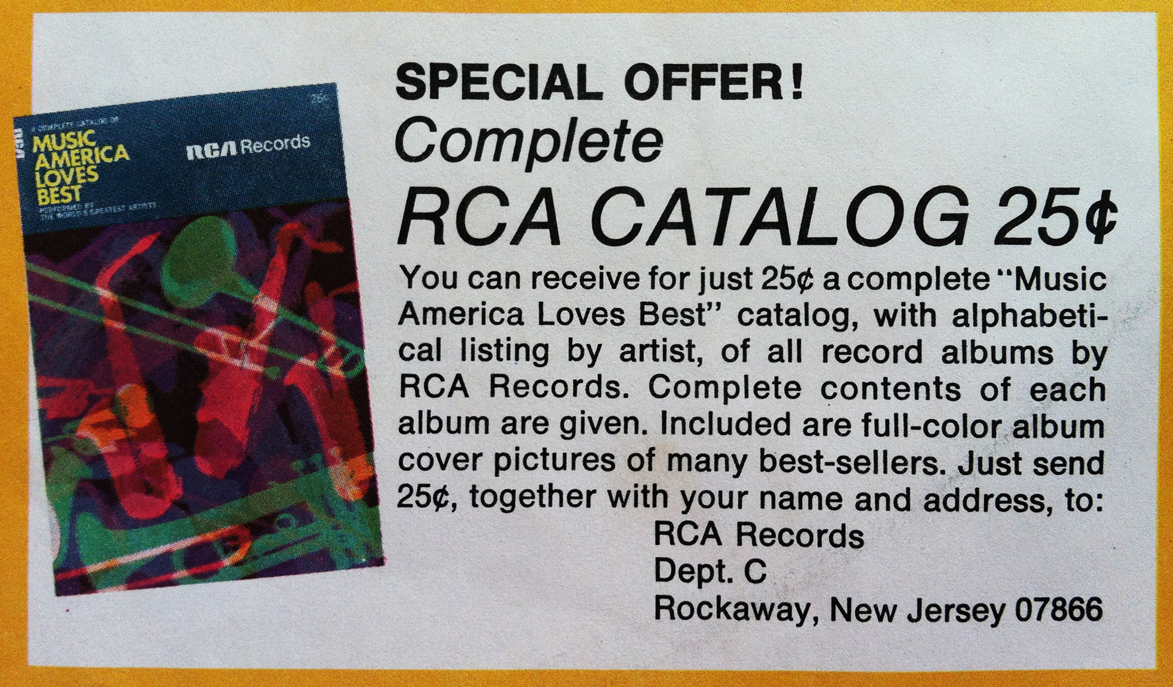
Special Offer!

Special OfferDescriptive words… in print… next to full-color album cover pictures… sent directly to the address of my choosing… for only 25¢? Sign me the hell up! This is the ecstatic line of thinking RCA Records had in mind when they advertised their loose leaf booklet on special insert sleeves of their record albums. The Record Album?

Titled “Music America Loves Best” this alphabetical catalog can be shipped directly to your doorstep (or conversion van’s side-door) for only one, easy payment of just 25¢. Upon receiving this staple of profound literature, you’d be awarded the opportunity to peruse a catalog “with alphabetical listing by artist, of all record albums by RCA Records.” No indication of ordering any of these records is provided by this special offer.

RCA Records (aka Radio Corporation of America Records) existed back before the Cubs won their last World Series, and for a measly 25¢, you could own a little piece of recording history… or at least the “complete contents of” the undisputed masterwork that is The Best of Eddy Arnold.

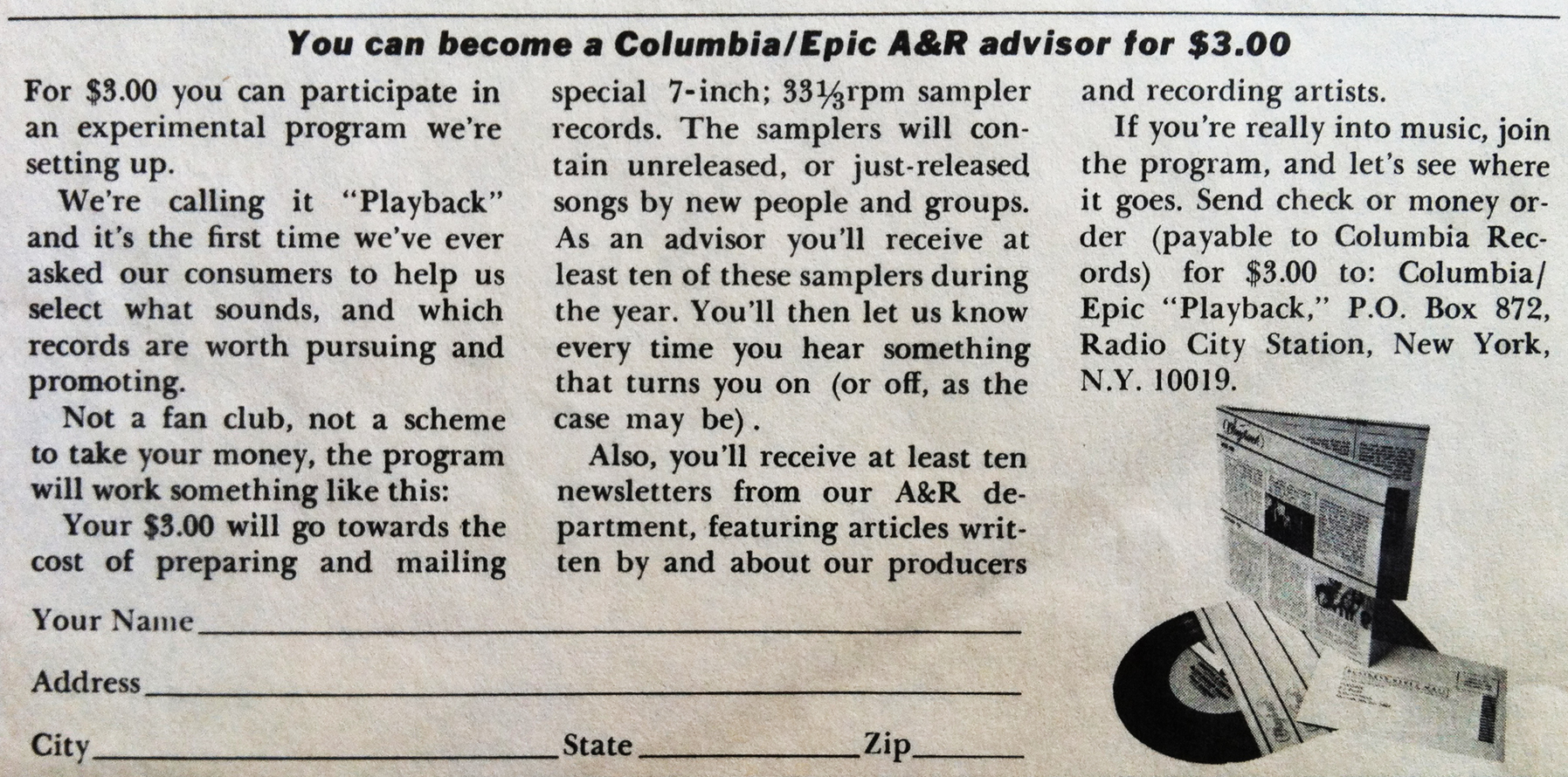
Become a Columbia/Epic A&R Advisor for Only $3.00

A&R Advisor AdvertIf you get a few moments, read this inventive mail-order program aimed at late 60s music connoisseurs (I’m assuming it’s from the late 60s as it was found in an album from 1968).

Basically, you’d send Columbia Records $3 ($19.53 by today’s inflation-soaked, nightmare-inducing terms) and over the course of one year, you’d receive 10 special, “7-inch or 33 1/3 sampler records containing unreleased or just-released songs by new people and groups.” After receiving these records, it was your duty as an A&R Advisor to inform Columbia Records which songs tickled your fancy, and which were better suited for the vinyl graveyard, also known as St. Vincent De Paul.

A fairly elaborate concept to comprehend today, given that the same back and forth info-swap between record labels and faithful listeners is now done via the cloud and email, this little piece of music history shows that just because it’s pressed doesn’t mean it’s good, and that just because it’s backed by a label, doesn’t mean they know what the hell they’re doing.

There’s hope for us yet.

A New World of Sound… On Decca

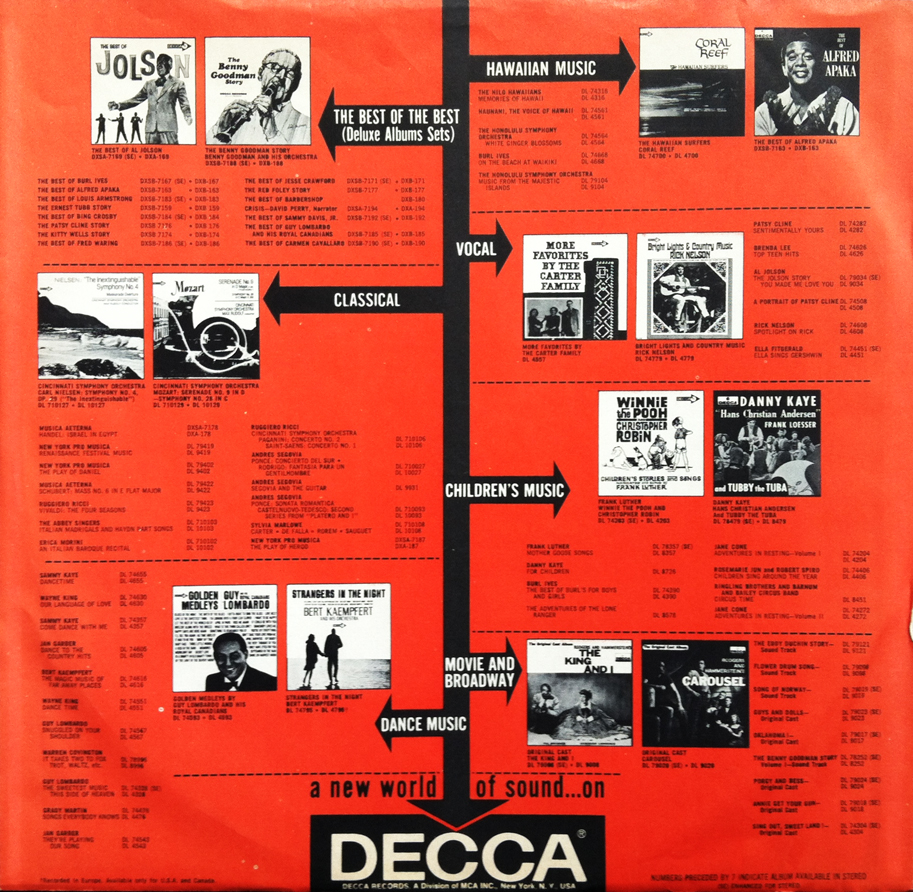
Decca Family TreeDecca Records spans an almost spectrum-like array of eclectic ear candy. Ranging from Children’s music (Winnie the Pooh), to Hawaiian music (Alfred Apaka), to Classical (Vivaldi), and last but certainly not least, to William Shatner (in whose 1968 album, The Transformed Man, I excavated this colorful insert).

It’s always interesting to see how creative these self-promoting record label inserts get in attempting to showcase their less-than-chart-topping-hit-records. I particularly dig this insert’s layout and how a simple arrow (repeated, obviously) can direct the eye to what the designer wants to showcase, and the order in which they want it presented. It’s almost a roadmap that effectively leads to the consumer’s ultimate destination… A New World of Sound… On Decca.

Le moins cher Sgt. Pepper costume vous verrez aujourd’hui

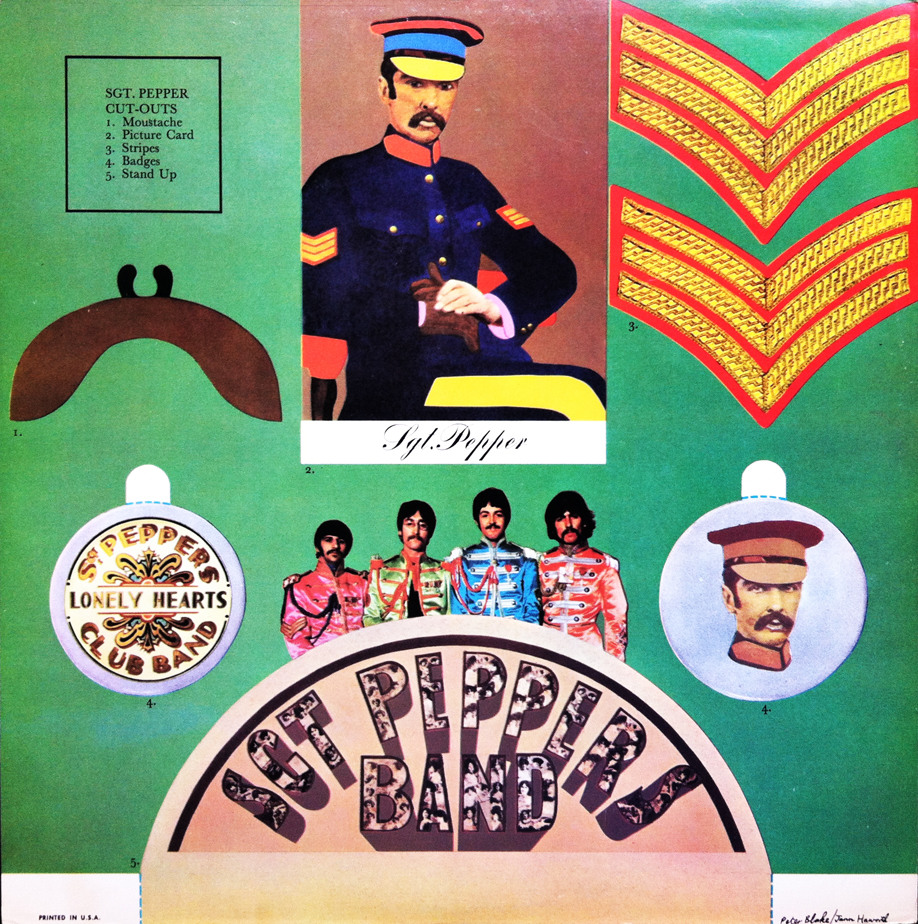
Sgt. PepperEver wondered what it would be like to walk in the mighty boots of Sgt. Pepper? Well, you can’t, so stop dreaming for the impossible, and come back down to reality because presented here is (not at all) the next best thing.

Tucked deep inside my rather dilapidated copy of Sgt. Pepper’s Lonely Hearts Club Band is this lovely little “costume themed” Sgt. Pepper insert. Some assembly is needed, but with minimal work (scissors are required), you can amaze and confuse your family and friends by dressing up as the honorable Sgt. Pepper.

This cut-out kit includes:

1. Moustache (No Sgt. Pepper impersonator would be caught dead without one.)

2. Picture Card (To pass off as a valid and law-abiding photo identification card, presumably when questioned by authorities, or children with worried looks in their eyes.)

3. Stripes (To keep your Sergeant arms warm.)

4. Badges (Nothing says you’re serious about your appointed duties like a badge with a picture of yourself posted proudly upon your heroic chest.)

5. Stand Up (No Sergeant, ESPECIALLY Sgt. Pepper, would be caught parading around without a psychedelic, four-piece band. Here is a picture of that band.)

Halloween is several months away, but you can practice your army-commanding stature with this lovely, and surprisingly accurate, cut-out costume. (Mind-altering drugs and sitar sold separately.)

This Protective Envelope

Capitol Protective EnvelopeThis protective envelope is a hoss! ­With its abrasion fighting, scratch deterrent capabilities, this protective envelope guards your record’s grooves like a well trained, and slightly hungry, Navy SEAL.

Dust, frosting, coffee, weapons of mass destruction… you name it, this protective envelope will not only terminate any potential harm set to attack your cherished records, it will publicly humiliate the enemy with a shaming and mocking tone.

This protective envelope doesn’t offer these prestigious promises for free. Prepare to treat this protective envelope as if it painfully, yet lovingly, emerged from your womb. Give this protective envelope the proper love, sympathy and attention it requires. Because, let’s face it… can we really put a price on our records’ safety and well-being? No. The answer is no, we cannot.

This protective envelope thanks you for your time and asks that you please wash your damn hands before thinking of laying a finger on your precious records.

High Fidelity Recording Ultra-Phonic Sound Sleeve

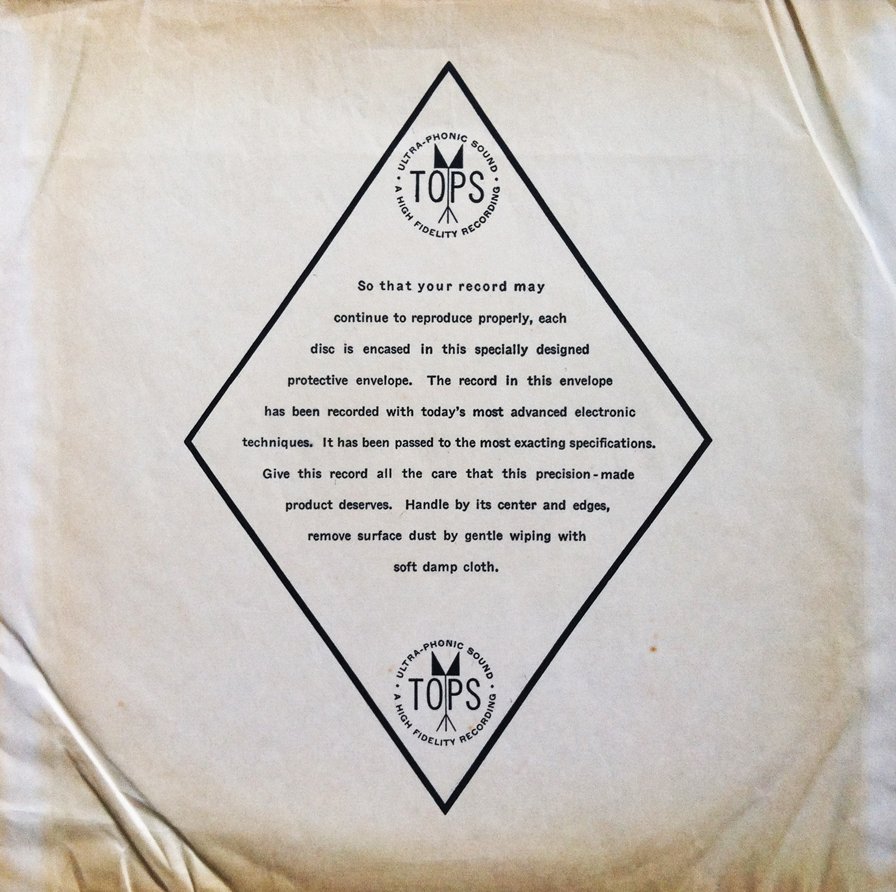
Tops InsertTOPS Records, and their “High Fidelity Recording Ultra-Phonic Sound” don’t want your records to get cold, so they conveniently offer “this specially designed protective envelope.”

Without your knowing, the sleeveless records in your prolific collection have been coming down with the vinyl flu (it’s been going around). Thankfully, sobby noses and sleepless nights are a thing of the past with this futuristic record protector by TOPS Records.

Tops LogoYour records give you so much unconditional joy… give back. Keep them warm. Make sure each and every licorice disc is kept safe and secure with its own protective envelope from TOPS Records. TOPS Records… clothes for music.

Wax Trax! Records Insert from 1986

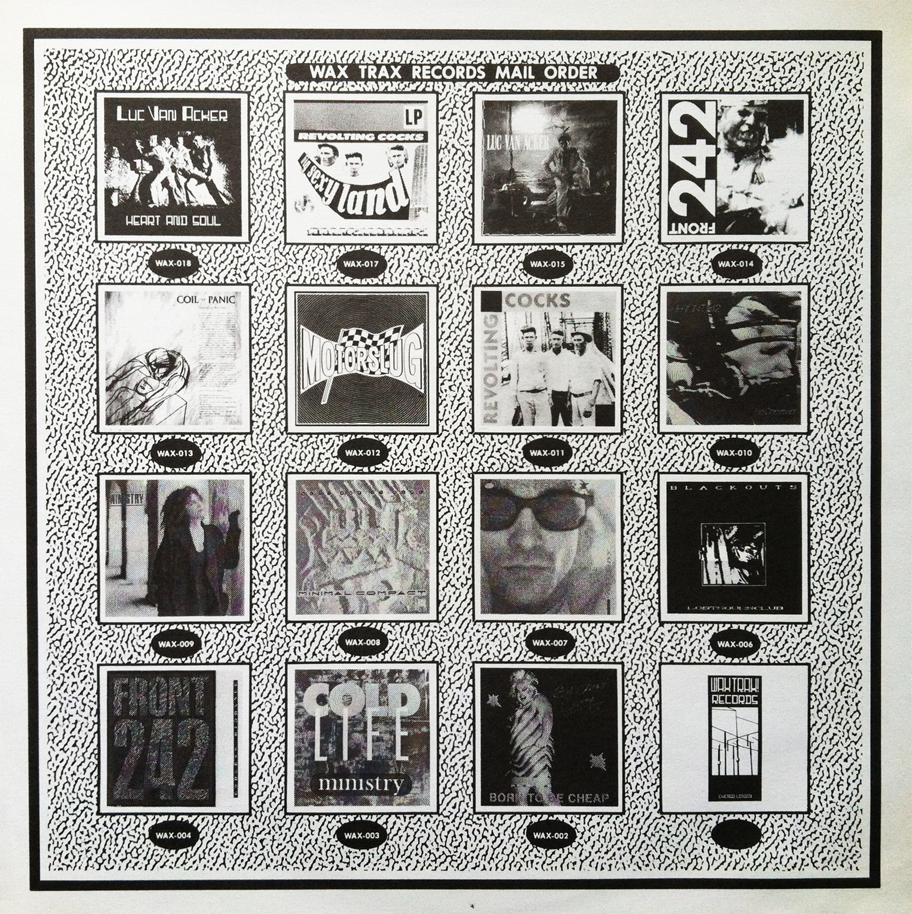
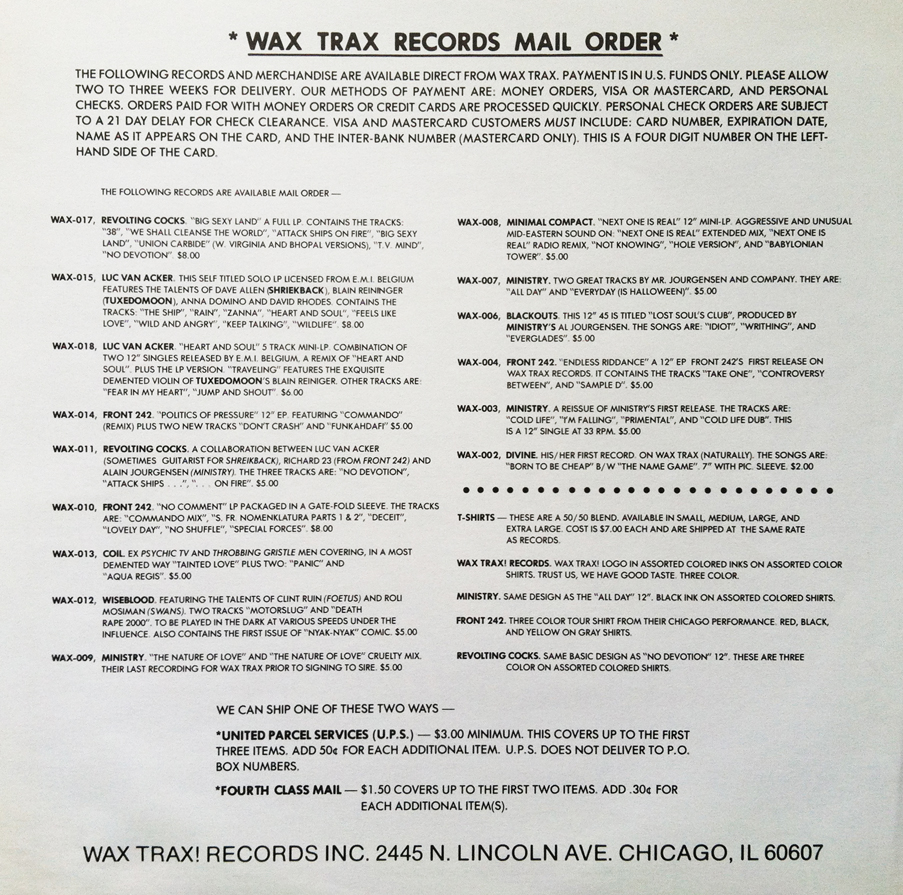
Wax Trax 1986 InsertFeatured today is one of the four (possibly five) different, albeit only to the trained eye, Wax Trax! Records inserts in my collection. It emerged from the deepest, and most sobering crevasses known to man (Luc Van Acker’s Heart and Soul, aka WAX018).

Listing the catalogue at only 18 albums (only 17 that were available at the time), this insert can be carbon dated to the fruitful, yet sardonically demonizing, year of 1986. In 1986, one could rest comfortably knowing they could, at any time, order the Al Jourgensen produced (Ministry, Revolting Cocks, Pailhead, Acid Horse, 1000 Homo DJs, Lard, PTP, Special Affect) Blackouts 12”, Lost Soul’s Club for only $5. (Which, in today’s world would only yield you a pint of half & half or a smug retort.) Found amongst the seminal releases from the grandfathers of the label are four different Wax Trax! Records t-shirts, many with varying sizes and colors. Those are $7, or about the value of two stamps today.

Wax Trax 1986 Insert BackThis is the 2nd Wax Trax! Records insert post from The Groove, and unless there is one hidden amongst my Ferrante & Teicher albums, this insert from 1986 is my oldest.

That is all. Have a good Friday.

Columbia Records Sleeve

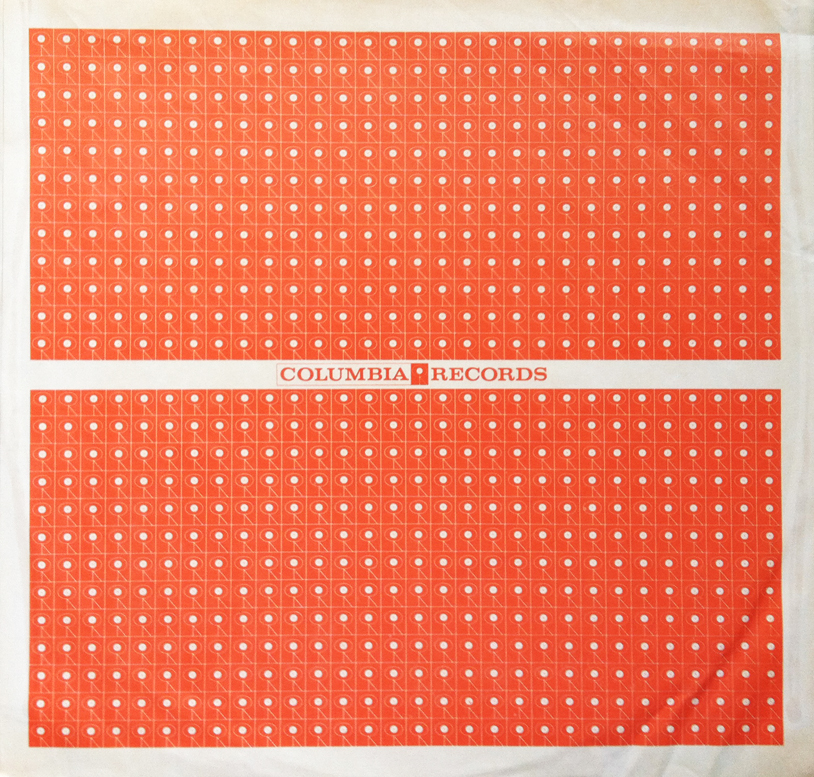
Columbia Records InsertIn lieu of today’s biggest release in the history of Columbia Records (which is an argument to be had, I know), I present a simple, yet elegantly designed sleeve from 196?

Using repetition, and a simple (not to mention inexpensive) two-color layout, the designers at Columbia Records produced an elegant piece of 1960’s design in the often hidden form of a protective record sleeve.

As you can plainly see, the Columbia Records logo is subtly patterned on either side of the centered, Columbia Records name. There is no question that a bold white line amongst a sea of orange logos was designed specifically to demand attention from the eye, and only after you’ve read the text do you realize the tiny logo creating the hemispheric patterns.

If you haven’t already, go out and pick up a copy of Daft Punk’s Random Access Memories. When you leaf through the futuristic (2013) album, think back to the mountainous Columbia Records catalog, and how simple, yet tasteful, their design (and musical) history was.

The Best, Biggest Bargains on Record!

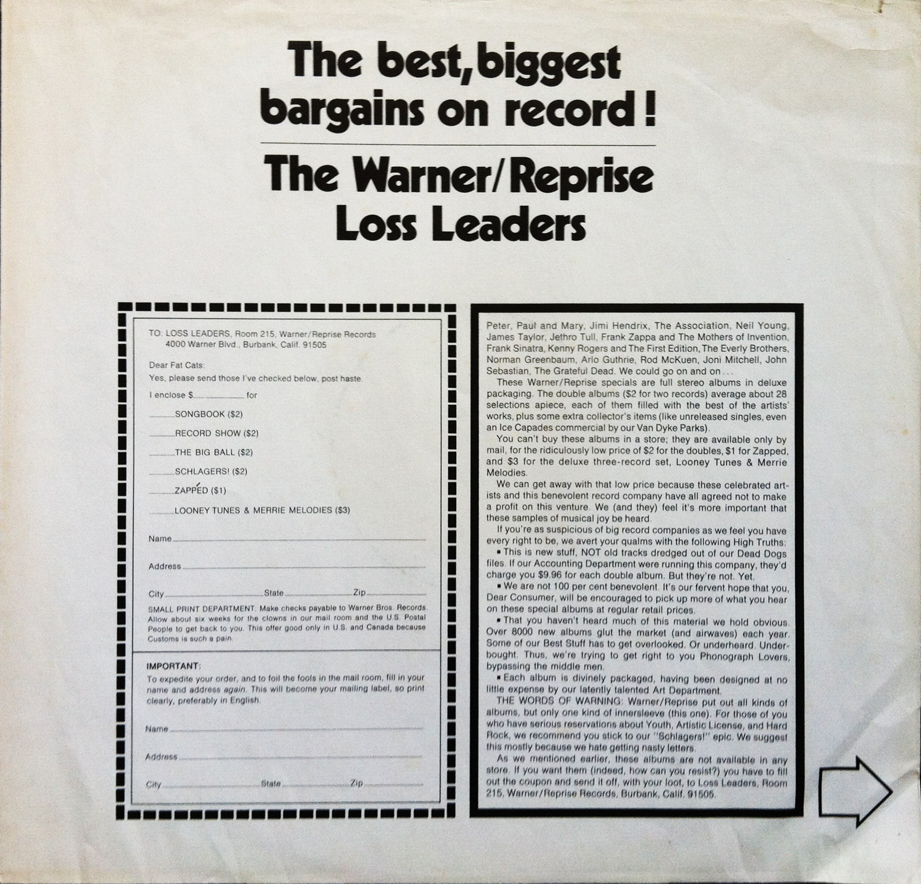
Warner CoverWarner/Reprise Records took a bit of a risk in late 1969/early 1970. Not only did they offer double LP comps for only $2 (at a time when single LPs went between $4 and $5), but also their “The best, biggest bargains on record!” campaign promoted exclusive albums at insanely discounted prices that were only available via this innersleeve. AND, as if that weren’t enough, their ingenious, cunning, and dear I say crackerjack copywriters presented this financially hazardous campaign with the youthful exuberance found only from the likes of Peggy Olson.

Here are a few examples of how fascinating “The best, biggest bargains on record!” campaign is, including, but not limited to, jokes and sarcastic dialogue (dialogue, from an insert?):

– Offering a coupon printed on the sleeve itself, Warner/Reprise suggests that the protective sleeve that was provided in a previously purchased Warner/Reprise album be destroyed and used to order more records.

– “To expedite your order, and to foil the fools in the mail room…”

– “Dear Fat Cats: Yes, please send…”

– “We can get away with that low price because these celebrated artists and this benevolent record company have all agreed not to make a profit on this venture.”

– “If our Accounting Department were running this company, they’d charge you $9.96 for each double album. But they’re not. Yet.”

– “If you want them (indeed, how can you resist?) you have to…”

– “If you’re as suspicious of big record companies as we feel you have every right to be…”

Warner BackIn closing, I would have loved to have been a fly on the wall when the idea for this campaign was introduced. I would have loved to have witnessed the look on the faces of Warner/Reprise Execs, and I would have loved to have shaken the hand of this campaign’s mastermind. (I would also love to pay only $2 for a double LP!)

Listen To Your World

Listen to Your World(Imagine a 33-year-old American male speaking directly to you, or to a camera, in a calm, soothing tone.)

When you purchase a used album, you really never know what you’re going to get. (Takes a few steps forward and smiles.) Hello, this is X from The Prudent Groove.

Not unlike downloading an album without the proper metadata, and we all know how annoying THAT can be, am I right?! (Takes a beat.) The level of quality attributed to a used record you find at say, a thrift store, is based solely on the mindset, (Beat.) and general care of its previous owner. (Looks down, then back up. Puts hands in pockets.)

Was the previous owner a neat freak who housed each of their cherished albums in overpriced, protective sleeves like we do here at The Groove? (Cocks head as to ponder this question.) Did they use the front jacket as a temporary table for rolling dried relaxation plants? (Beat.) Were they careless and used the back cover as a coaster, leaving a circular ring of ancient coffee above the “we’re trying to look casual” picture of the band? (Lets out a slight chuckle.)

These questions, and any others you may have of a record’s previous owner, will fall upon deaf ears, and the answers will only exist within our own imaginations. (Sits down on a chair. Where did the chair come from?)

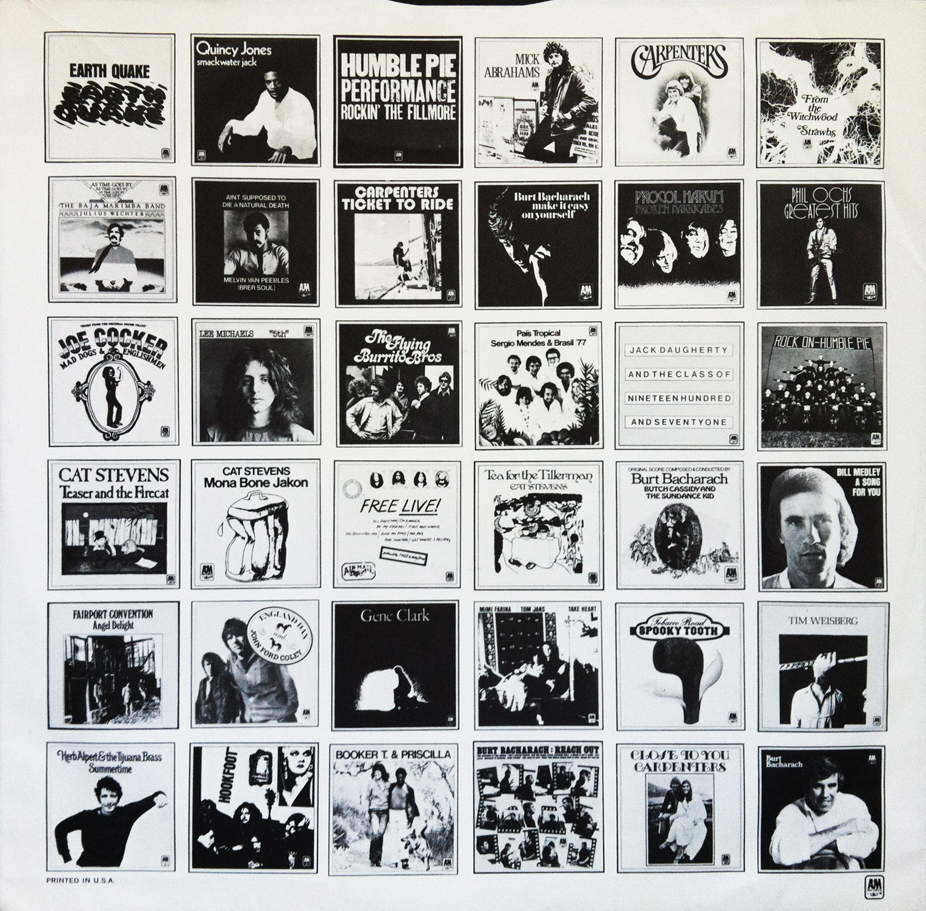
Take for example this A&M Records insert I found inside my copy of Johnny Cash & Jerry Lee Lewis’ Sunday Down South album on Sun Records. (Holds up record, not pictured here.) The previous owner either didn’t care, or didn’t notice that the insert didn’t match the album. Not a very big deal as the record is in pristine shape. (Chuckles.) The previous owner probably didn’t enjoy the music and never played it, and THAT’S why it’s in such good shape. (Stands back up and begins walking.)

A&M Records Sleeve“Listen To Your World” is a clear-headed marketing slogan from A&M Records that suggests “your world” (Does quotes with his fingers… incorrectly.) can only be found on A&M Records. Clever girl. (Says in terrible British accent.) The flipside to this slogan showcases some pretty heavy-hitters from the A&M catalogue. (Looks down at insert as if to read.) Cat Stevens, Herb Alpert, Humble Pie, Quincy Jones and Burt Bacharach to name a few. With no date affixed to this insert, the words, “Listen To Your World” seem to become as timeless as some of the classic releases found on A&M Records. Coupled with the bold, white text on a basic, black background, this modern day musical proverb is a strong, and I hope profitable, marketing campaign for A&M Records, one that I’m happy I stumbled upon in an almost unorthodox manner.

Take a little mental trip on your next hunt through your local second hand store, and give a distinctive personality to that record you can’t live without. (Puts hands in pockets and smiles.) The album, like the music, exists as an entity in and of itself. Give it a history, and your collection will come to life in ways you never imagined.

This has been X from The Prudent Groove. (Smiles and puts hands on hips.) I’ll see you here tomorrow. Have a great afternoon. (Walks away in an awkward, no idea where he is stroll.)

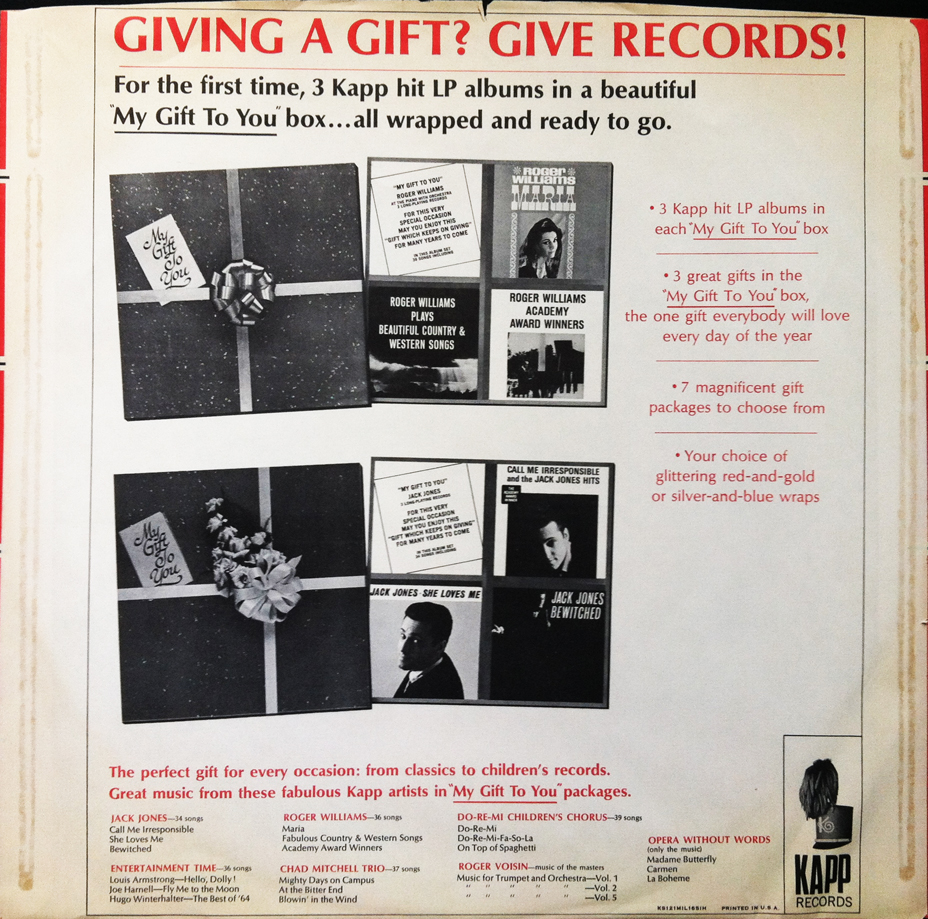
Giving A Gift? Give Records!

KappHave a nephew who’s grown tired of his plastic Slinky because it’s lost its slink? Consider cheering him up with a beautiful “My Gift To You” box from Kapp Records. With over six “magnificent gift packages to choose from” (exactly seven), your gracious nephew will be the envy of every kid on his block for years… strike that, DECADES to come.

Got a friend who’s down in the dumps because his fiancé forgets to shut the cupboard doors each time she opens them? (#sniff) Why not surprise him with “the one gift everybody will love every day of the year”? With these perfect gift boxes, you can even customize the wrapping on the box! (Well, as customizable as choosing between either red-and-gold or silver-and-blue wraps.)

With such chart topping, breakout artists as Roger Voisin and the Chad Mitchell Trio, “My Gift To You” boxes by Kapp Records are ideal gifts for even those of your classy friends who don’t really enjoy music. Forget giving people what they want, give them a “My Gift To You” box from Kapp Records. They truly are “the perfect gift for every occasion.”

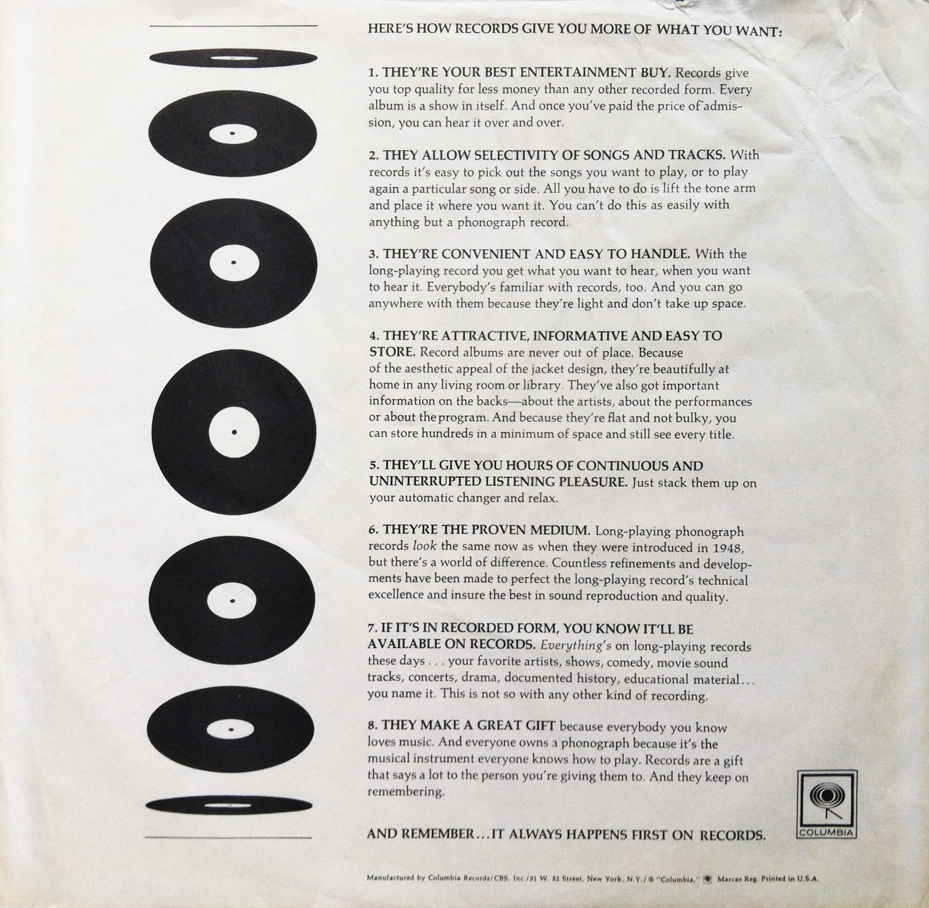
It Always Happens First on Records

Here’s How Records Give You More of What You Want:

New Columbia Insert1. They’re Your Best Entertainment Buy. Forget about your relationship with touch-screen baby wipes and bowel movement status updates. The vinyl record is way more entertaining than that new Smart (fill in the blank), and it’s cheaper too. Cheap is good. That means you can finally afford that sticky tattoo-removal procedure so you can forget about that regrettable weekend in Cabo.

2. They Allow Selectivity of Songs and Tracks. Gone are the archaic days of slaving through an entire album’s worth of songs. Feel the need for a quick spin of Obsession by Animotion but don’t want to wade through the dull, 8 filler tracks? With records, you have that option.

3. They’re Convenient and Easy to Handle. They’re not say, as convenient as an automatic fish feeder or adequate plumbing, but records are more accessible than lugging Mott the Hoople around with you everywhere you go.

4. They’re Attractive, Informative and Easy to Store. Forget those overpriced, dysfunctional dating sites. Records are attractive, smart, funny, and they won’t mind if you don’t wash your shirt laundry as often as you probably should.

5. They’ll Give You Hours of Continuous and Uninterrupted Listening Pleasure. Hours? Yes. Uninterrupted? I can think of a few times records may interrupt your listening flow. Like say, when you need to flip the record to play the 2nd side, perhaps?

6. They’re the Proven Medium. This one is true. I mean, we all know digital files are on their way out. Am I right?!

7. If It’s in Recorded Form, You Know It’ll be Available on Records. Ever get the hankering for the smooth, swinging sound of Richard Nixon and his administration conversing about secret, and often illegal activities? It was recorded, so there should be a record out there somewhere.

8. They Make a Great Gift. Kids love ‘em, old folks love ‘em, and your local grocery store owner’s mistress loves ‘em. They’re like cats. They make a great gift.Spinning Record

The Triple P

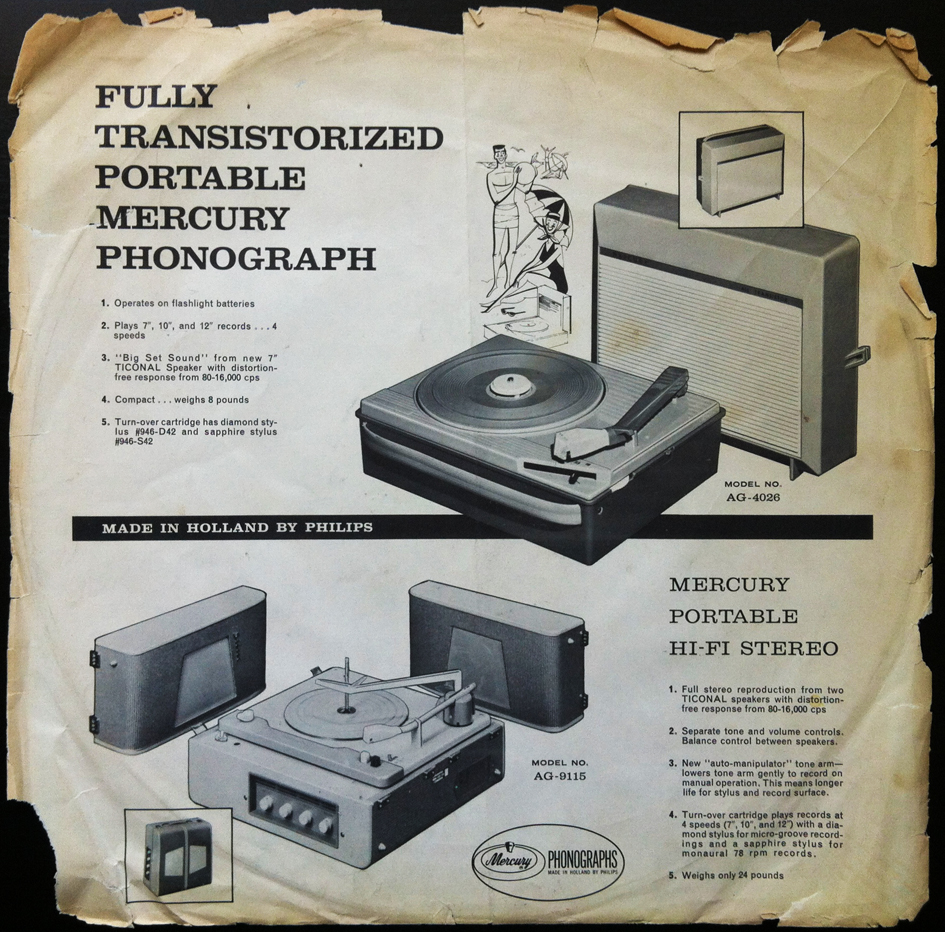
Mercury Phonograph InsertOn my quest to find the perfect portable phonograph (the Triple P, as I call it), I stumbled across this weathered insert from who-the-hell-knows-when. A quick Google search reveals that Philips began manufacturing these beauties in 1963, so I guess, now-we-all-know-the-hell-when.

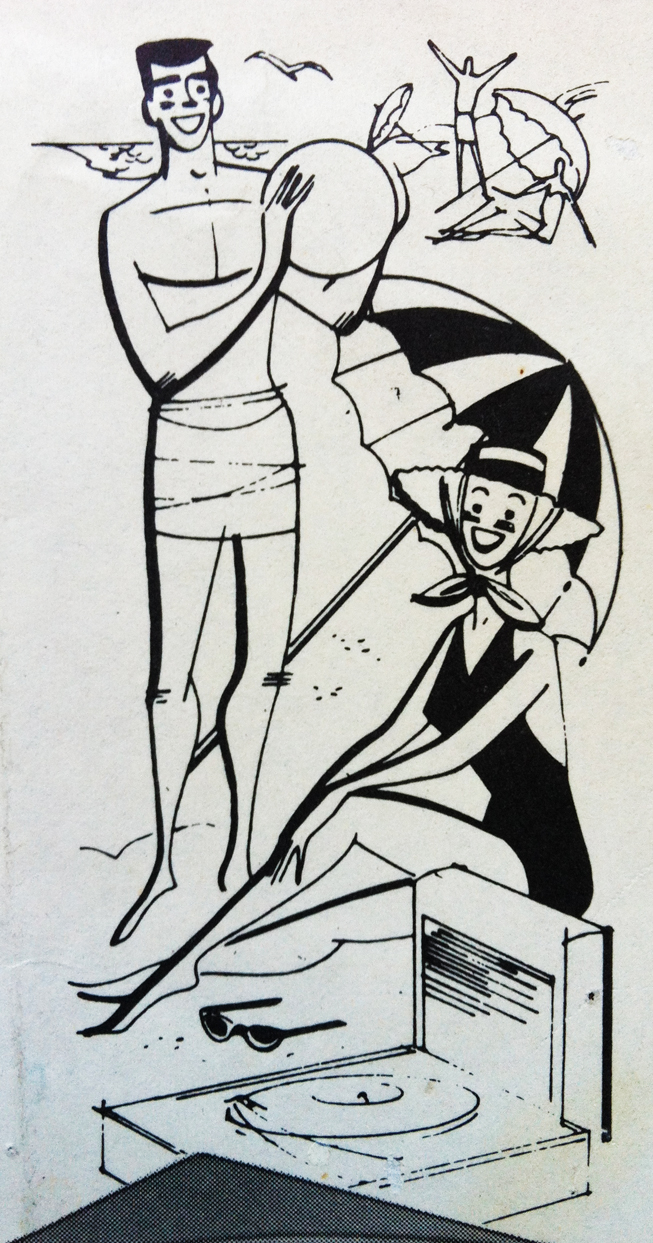
This insert features two, distinctly different looking players. First is the AG-4026. This compact player is perfect for annoying your temporary beach neighbors with your controversial Lenny Bruce albums, and plays 4 speeds on 7”, 10” and 12” record. Operating on easily accessible flashlight batteries, this lightweight (8 pounds) transistorized phonograph offers distortion-free response from 80-16,000 cps from its new 7” TICONAL speaker. The word around the waves is that it’s the “Big Set Sound” so, there you go.Beach Bums

The second is the AG-9115. Think of the AG-4026 as being the “Four” series and the AG-9115 as being the “Nine” series. This is NOT a kids toy. This portable Hi-Fi STEREO phonograph provides two TICONAL speakers, separate tone and volume controls, a new “auto-manipulator” tone arm and weighs a slender 24 pounds. Alright, that may be a little heavy to tote around on a bike trip or on a romantic picnic, but I’d still love to see the AG-9115 in action.

Made in Holland by Philips, these two portable players, one mono and the other stereo, would be perfect for my everyday record-listening mobile needs… if, you know, it were still the early 60’s. My hunt for the Triple P marches on.

Music by the Hour

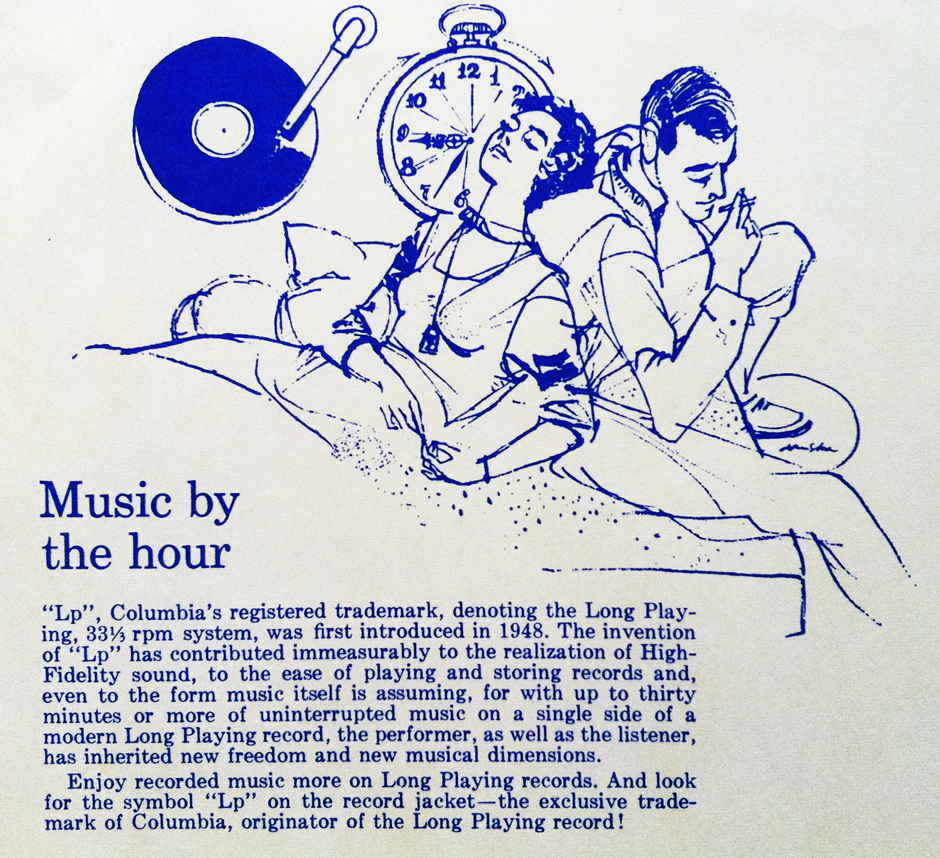
Music by the HourYet another insert? Either I’ve got a stockpile of particular inserts, or I’m excessively lazy. The jury has been out for over a week.

There’s a lot to learn from an insert. They’re a time capsule filled with images and ideas of what men in suits, getting paid a lot of money, thought people desired. They’re ripe with branding, marketing ploys, and artists’ renderings of “regular people” enjoying their product. In this particular case, its Columbia Records.

Columbia Records was pretty monumental in the heyday of record utopia. Here are a few facts that Columbia Records would like you not to forget. These, and others, can be found within this iconic promotional advert. Who knew learning could be so stunning?

– The “LP” (short for Long Play) was introduced by Columbia Records and was legally backed by a registered trademark.

– Men liked to smoke.

– The “LP” debuted in 1948.

– Women enjoyed picking their nails while listening to music by the hour.

– “LPs” allow for up to thirty minutes of music per side. That’s up to one full hour of music!

– Women loved to lean, uncomfortably, on the backs of men.

Post #60: The Insert that Stopped Time (If Only Briefly)

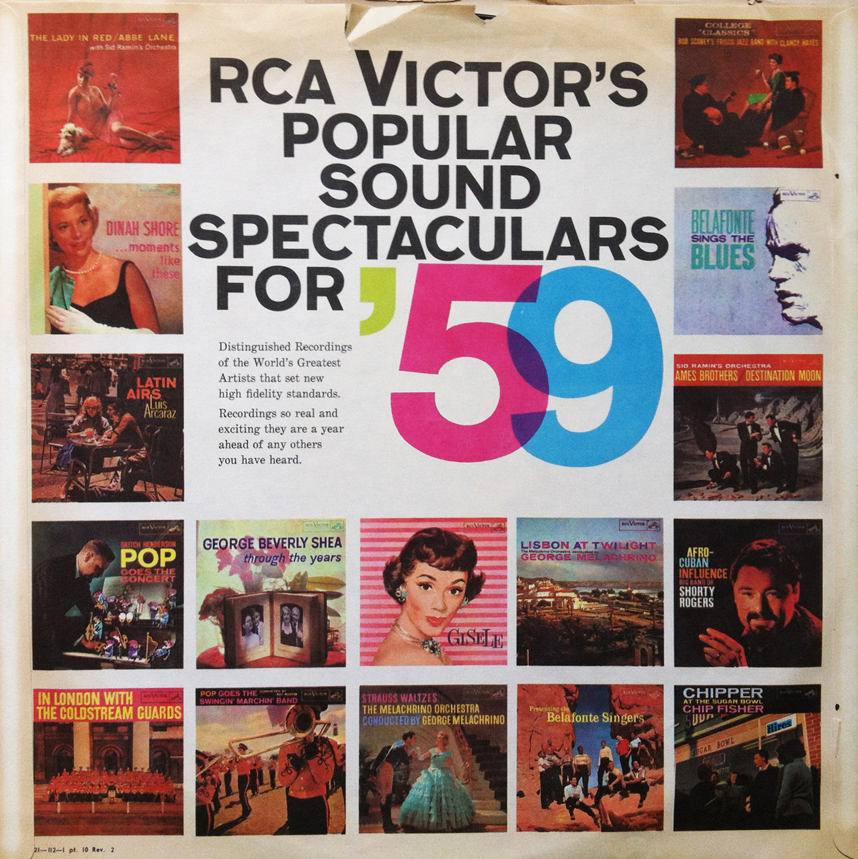
'59 Insert_SmallerThe curious reader asks, “Hey P. Groove, why wasn’t this fine looking insert from ’59 YESTERDAY’S post topic?” I’ll tell you, inquisitive peruser of yesteryear gems… and it may, or may not involve Don Draper.

Thank Artie Shaw and his 1958 album, A Man and His Dream, for this Madison Avenue beauty. A modern approach to selling a catalog of varied taste, this insert, with its subdued album-stacking design, pushes the consumer’s focus to its center, where we find the two, overlapping numbers of illuminating nobility: 59. This eye-grabbing approach renders an immediate connection between that number’s meaning (the year), and the everyday existence of this album’s original buyer. To look at this insert in 1959, is to self-reflect on the years that preceded it, and to project future hope into the years that follow. In other words, this insert stops time for a split second to offer deep cogitation.

Needing to reach the hip cats of Latin Airs, as well as the squares of Strauss Waltzes (I own Strauss Waltzes, so my insults only cut so deep), RCA Victor’s approach to reaching the spectrum of 1959’s musical audience needed to be forceful, yet memorable. I believe stopping time for meditation achieved this goal. Nicely done, Mr. Draper… nicely done.

You’ll see, neatly tucked into the corner of Latin Airs and George Beverly Shea’s Through the Years, the thesis to this modern advert:

Recordings so real and exciting they are a year ahead of any others you have heard.

Exactly one year… 59+1=60. And thus, Post #60: The Insert That Stopped Time (If Only Briefly) finds its inevitable message.

Free Fact-Packed Book

Cert BackMarketing records can be an embarrassingly hilarious industry. From the album cover, to a free book on The Wonderful World of Country Music used as incentive for consumers to purchase and collect 5 insert certificates, it seems as though Time Life Records in 1981 would go to great lengths to confirm the sales of their Country Music series. Such a clever title for a series, don’t you think?

Let’s take a look at the top selling points for The Wonderful World of Country Music, shall we? I mean, if I’m going to hunt down four more albums in the Country Music series in order to get this “free” book, I’m going to want to know what I’m in for, right?

Cert FrontFirst off, it’s a “big” book. This certificate was nice enough to offer the book’s dimensions (8-1/4” x 10-3/4”). Second, it contains 240 pages and the biographies of more than 150 stars! ARE there 150 stars in country music? And I’m talking about the GOOD country music here. Maybe that “150 stars” thing was a typo and they meant the “15 stars.” That makes more sense. Third, this book contains the history of the Grand Ole Opry. Alright… any country music lover worth their weight in Hee Haw one-liners NEEDS the history of the Grand Ole Opry. Forth, you get an intimate glimpse into the astrological future of your favorite 15 stars by the horoscopes offered in this monumental book, and finally, “bluegrass, outlaw, oldtime.” I’ve got to admit, I have no idea what the hell that means. Perhaps the book touches on these off-shoots of Country music? Yeah, no idea.

I’ve got to say, I’m not entirely sold on this ploy, but a quick ebay search yields five The Wonderful World of Country Music auctions currently underway. So, at one time, somebody found these selling points irresistible… but the novelty must have worn off because now the book can be had for only $4.74. Tempting…

Barbi Mandrell

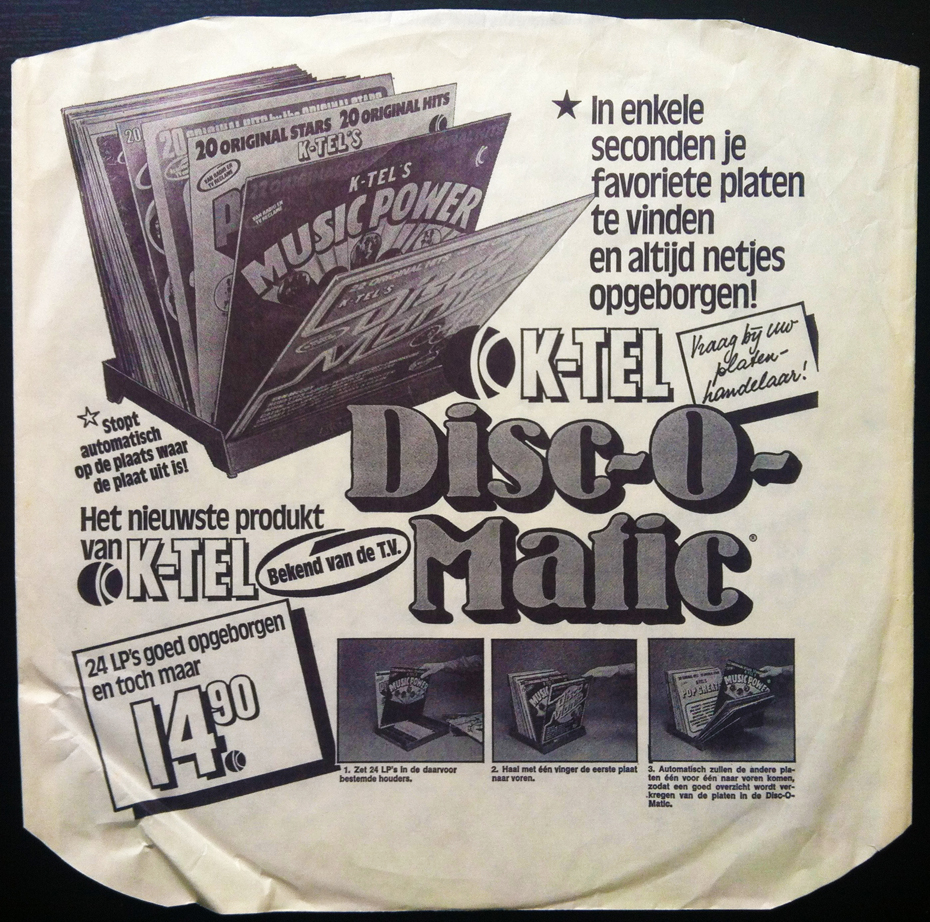
K-Tel’s Disc-O-Matic

Disc-OLodged inside an obscure comp album from the Netherlands, this glorious insert advertises K-Tel’s celebrated Disc-O-Matic in pure, late 70’s peculiarity. Printed almost entirely in Dutch, this ad boasts about the magnificent wonders of this record organizer that’s bekend van de T.V. (known from the T.V.).

Holding 24 LP’s, this chincy looking piece of plastic allows in enkele seconden je favoriete platen te vinden en altijd netjes opgeborgen (in a few seconds your favorite records to find and always neatly stowed away), or something. There is a bit of disconnect between languages on Google Translate, but you get how amazing this gadget is.

So, for 1976’s 14.90 (roughly $76.74 today), you could be the proud owner of K-Tel’s Disc-O-Matic. It’s known from the T.V., people! What are you waiting for?

Interesting how there’s no contact info for K-Tel. Oh!!! I guess Vraag by uw platen-handelaar means roughly, “contact your record dealer.” So, this upcoming Record Store Day, be sure to ask your local brick-and-mortar about K-Tel’s Disco-O-Matic. You’re sure to disappoint yourself.

What is STEREOPHONIC SOUND? (Part 3)

What is Stereophonic Sound Logo

Over the past few days we introduced the notion that stereo, and the intricacies that make up stereo, may not be widely known to those enjoying her esteemed capabilities. So, in this dramatic conclusion, The Prudent Groove offers, without sarcastic interruption, the cliffhanging outcome to, What is STEREOPHONIC SOUND?

RCA Victor Horizontal Logo

Presented by RCA Victor

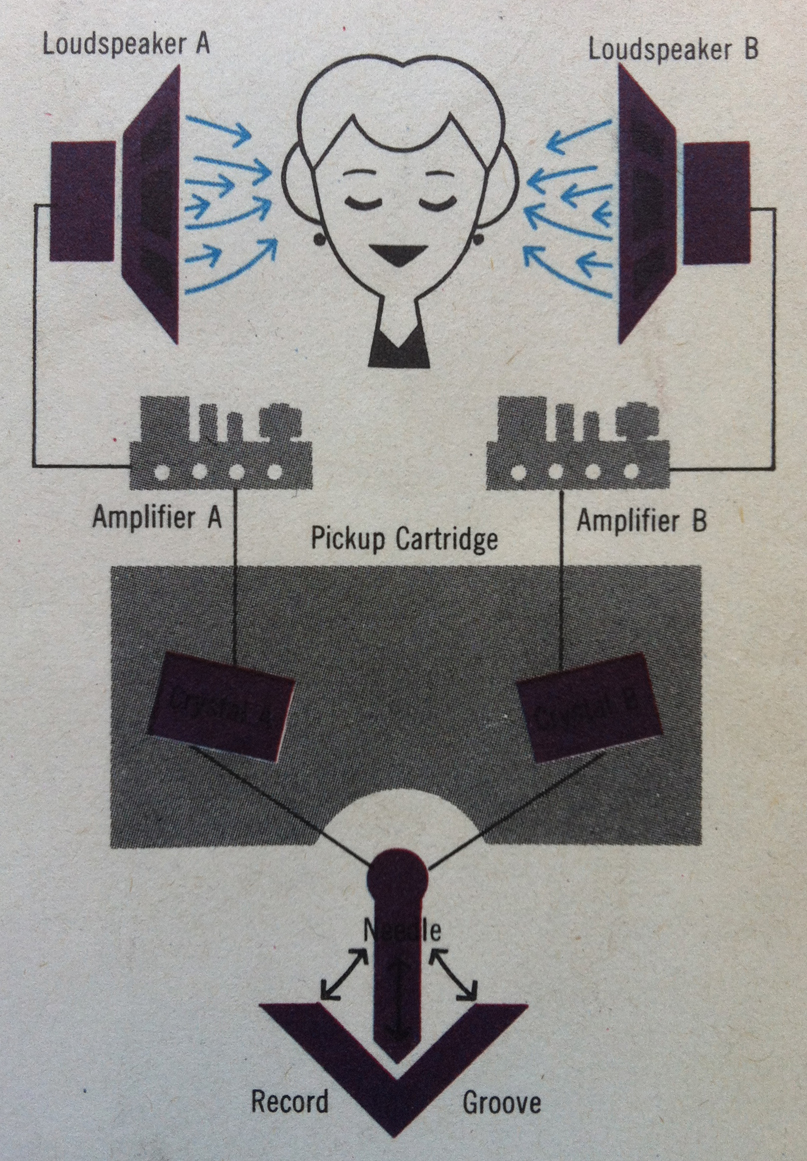
The two channels of sound picked up by the needle are then unscrambled by the stereo cartridge. The cartridge directs them into separate amplifier circuits, where they are magnified and fed in turn into two separate loudspeakers. The two speakers finally translate the musical impulses into intelligible sound which you hear in your living-room stereophonically.

Stereo Diagram Woman

The net of it is an overlapping and blending which gives music a more natural, more dimensional sound. For the first time, your ears will be able to distinguish where each instrument and voice comes from-left, right or center. In short, enveloping in solid sound, you will hear music in truer perspective.

Stereophonic sound is the latest step in an improvement process that began about 80 years ago. In listening to it, you will enjoy the highest achievement yet in the art of recording.

"Go Stereo" Type

What is STEREOPHONIC SOUND? (Part 2)

What is Stereophonic Sound Logo

Yesterday we inaugurated the intricate fascinations of Stereophonic Sound. Today, we pick up where we left off and continue with RCA Victor’s detailed explanation of the technical differences between recording a monaural record with that of the stereophonic record. So, without further ado, I present part 2 (out of 3) of RCA Victor’s What is Stereophonic Sound?

RCA Victor Horizontal Logo

Presented by RCA Victor

Let’s compare hearing to seeing for a moment. You see images on your left with your left eye, images on the right with your right eye. Yet, because your brain can do two jobs at one, you get a total unified picture in its true perspective.

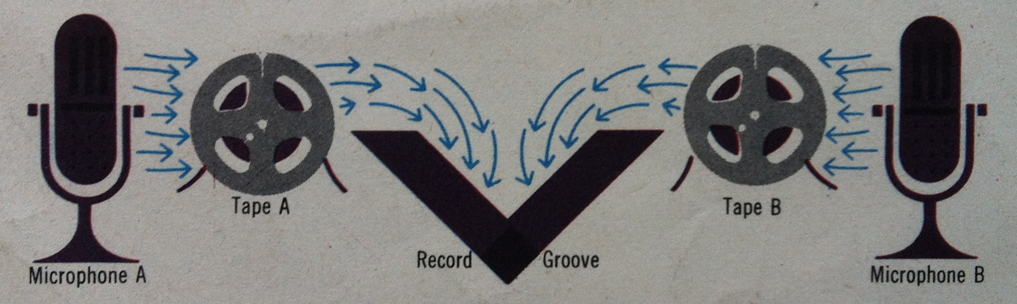
Stereo sound is simply the attempt to give you music as it is heard by both ears. Essentially, what happens is that two microphones, left and right, pick up what goes on in the orchestra at the recording session. These two microphones feed the musical impulses to two soundtracks on tape. The two soundtracks are then pressed into the grooves on a stereo record.

Stereo Diagram Needle

The sound from a record partly depends upon how the needle moves or vibrates. For example, when Edison designed his phonograph to play cylindrical records, he made the needle vibrate up and down. This is called the “hill and dale” system, or vertical cutting.

On a conventional, monaural record, however, the needle moves from side to side, or laterally. The lateral movement has been used ever since the flat record replaced Edison’s cylinder.

What about the stereo record? Each groove on a stereo record has two soundtracks cut into it, and they are cut into it both laterally and vertically. In order to pick up the two soundtracks, a stereo needle capable of moving complexly has been developed; it vibrates both laterally and up and down. Simultaneously, the lateral movement picks up one channel of recorded sound, the vertical movement the other.