UK vs. US

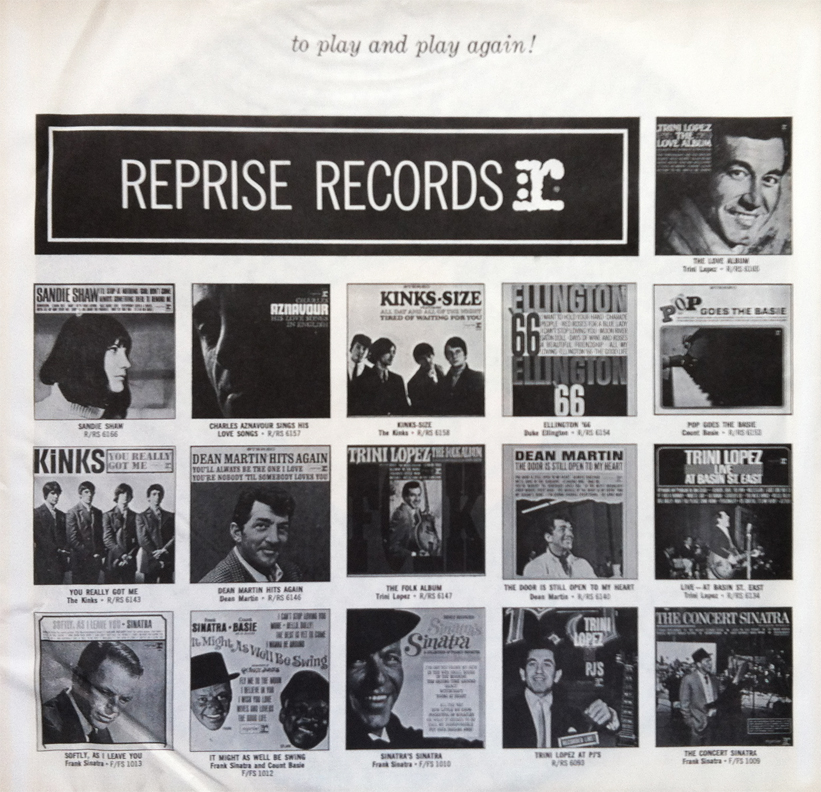
Reprise InsertWhy the UK and the US didn’t get along is something I’ve never been able to comprehend. Oh sure, things may be all fine and good now (for now…), but back in the day (and before my time), it seems that ego took precedent over creative output. Case in point, this Reprise Records insert from (roughly) 1965.

Featured on this beautiful little rock artifact (rock-ifact?), are two albums, or rather fabrications released by The Kinks. First (left side near the bottom) is the US version of their 1964 debut called simply, The Kinks. The original track lineup, cover art and title have been ignored for the supposed candy-grabbing, fat-bellied, narrow-minded delights of US audiences. Here it is titled You Really Got Me. There, it’s appropriately titled The Kinks. Why the change? Yet another age-old question whose real answer has been mummified and lives buried within the damp and dusty crypt of music’s blotchy past. (Wikipedia offers their decent explanation of this butchering practice that can found here.)

Second, and along the same lines is 1965’s Kinks-Size (middle). Here, US meatheads grabbed material from the EP Kinksize Session, leftover tracks from their debut, and both sides to two of their singles, Tired of Waiting for You and All Day and All of the Night. This Frankenstein makes for a decent listen, because let’s be honest, there really isn’t a bad Kinks song (before 1973), but it’s disjointing and certainly NOT what the band had intended. Wankers, the lot of them!

So, what’s the point? I dunno. Why couldn’t we all just get along? That, or I just really dig old inserts. Carry on.
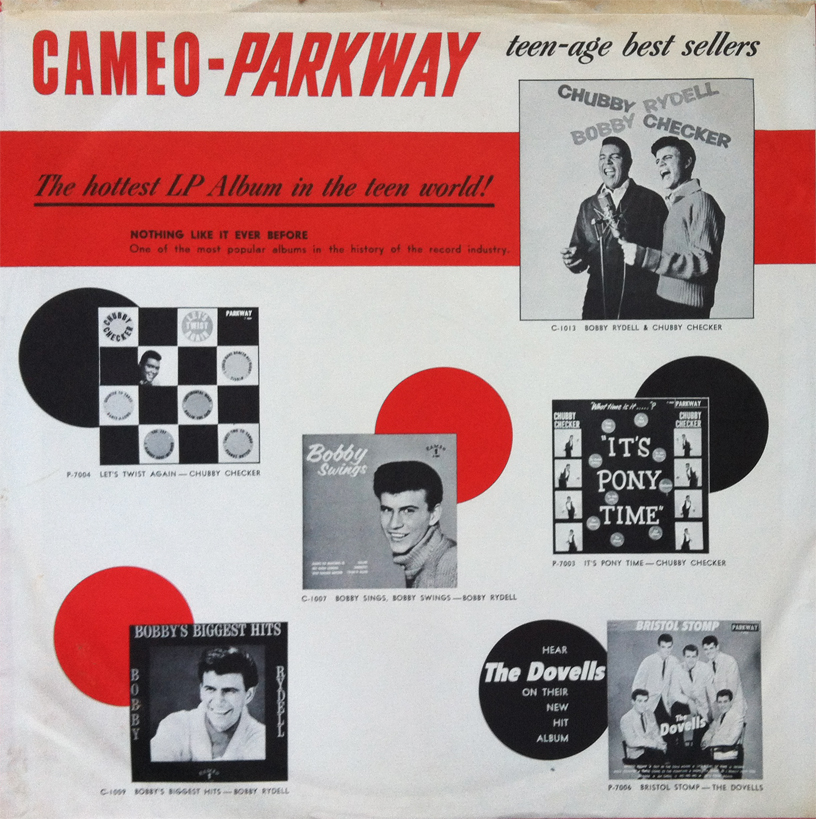
The Hottest LP Album in the Teen World!

Teen-Age Best Sellers“It’s Pony Time” here at The Prudent Groove, and we hope you didn’t forget to pack your fluffy turtlenecks, your mid-Roxanne singing face, your spotted checker board (a chubby thickness is preferred, but not required), and of course, “one of the most popular albums in the history of the record industry!”

Apparently, by 1961, the one-two punch of Bobby Rydell & Chubby Checker was considered one of the greatest musical achievements the world has ever seen! I’m certainly not knocking either Bob or Chub, but it’s somewhat easy to see how the explosion of teen-friendly, NON-twist-inspired music was so effective when it hit the unsuspecting faces of vocal-chord-screaming teens just a few years later.

Milked within in inch of its life, The Twist, and the plethora of deviations it spawned, lived an extremely short life when considering what timeless masterworks would follow it with the onslaught of the British Invasion. Twisting, it seems, is like the Macarena. You never really forget how to do it, but there are certainly times when you wish you could.

Introducing, the Color Purple

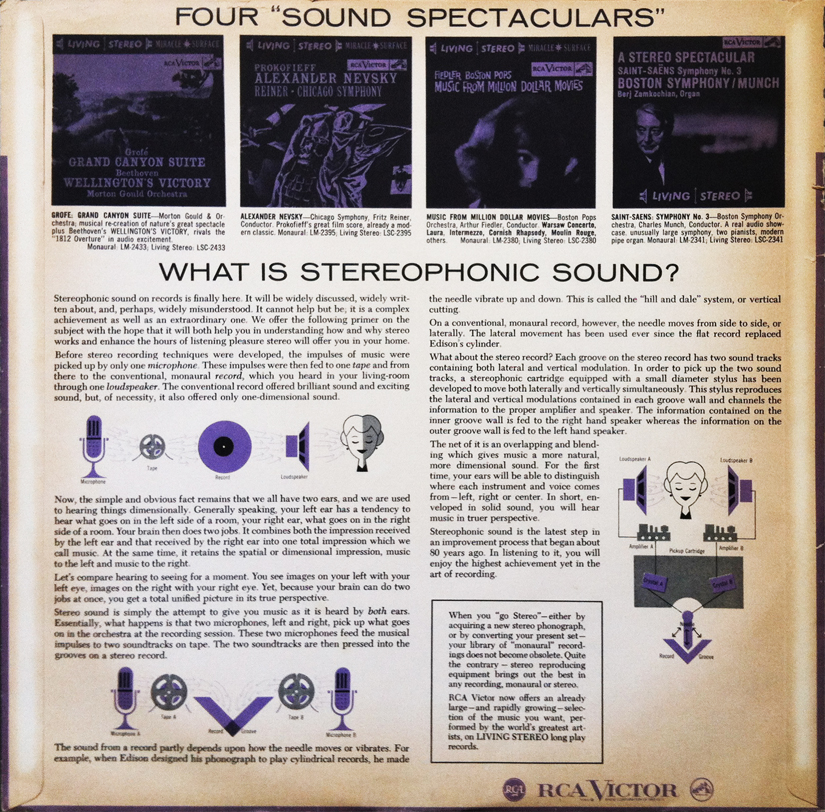
Stereophonic PurpleBy now, we’ve all been schooled in the revolutionary ways of stereophonic sound (Part 1, Part 2, Part 3), but there have been significant advances since mid-March that will set the standard in audio technology. Ladies and Gentlemen, stereophonic sound is now available in the color PURPLE! That’s right! At no additional cost to you, the color purple has been integrated into the RCA Victor demonstration insert. Discount blue RCA Victor stereophonic sound demonstration inserts are currently on sale to make room for this year’s fall fashion purple extravaganza. With the holidays coming up, why not give the gift of blue, or if you’re one of the lucky ones whose ship has come in, why not spring for the new purple model? Discounts on the discontinued blue will be applied at the register.

Offer Expires December 31, 1970

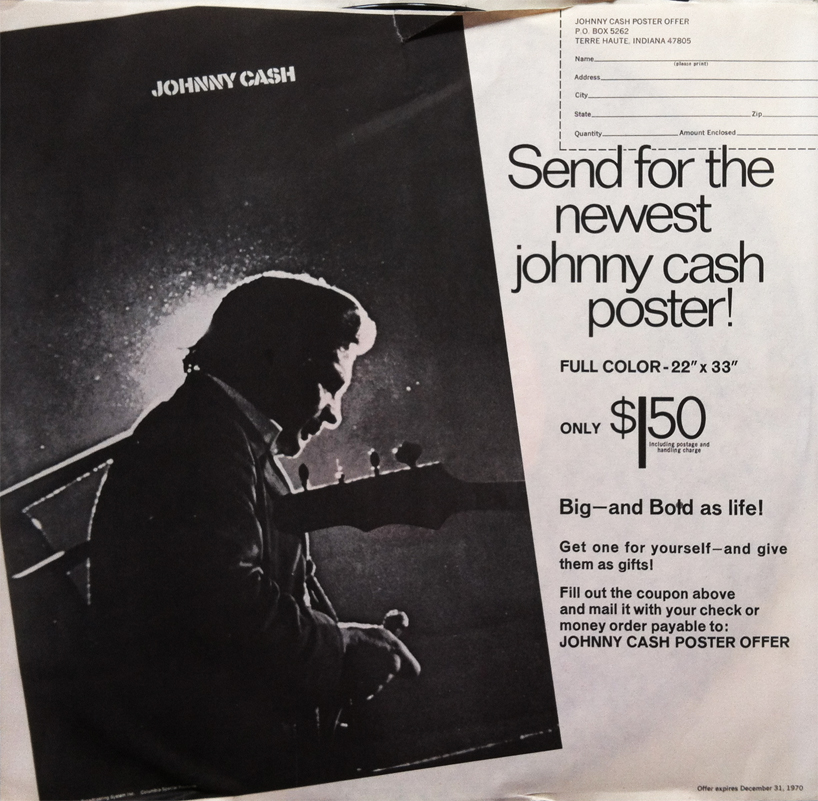
Johnny Cash Poster OfferSend for the newest Johnny Cash poster! So reads this adsert from the house copy of Hello, I’m Johnny Cash. I mean, come on (read, COME OWN), people! This is a 22” x 33” mother sucking poster that is as big and bold as life! BIG… and BOLDAS LIFE! You’re wasting time! Drop whatever you’re doing right this God-given second! Feeding the baby? Well, maybe don’t drop the baby, but rather, set the baby down on the linoleum next to Thomas the Train and this month’s copy of Bon Appetite magazine, and ORDER! THIS!! MOTHER LOVING POSTER!!!

As an avid Tim Hardin fan, I was pleasantly surprised to discover that this collection of field-tending utterances (of creative genius) fashioned a JC version of the song (arguably, Tim Hardin’s most famous), If I Were A Carpenter. Death makes legends of mediocre men. Such is not the case with regards to both Hardin and/or Cash. 1969, the year of this album’s release, I imagine, was a tempting and paranoid time. I never saw 1969… I never breathed the tree-hugging stench of the summer of love, but I am, however ill fashioned, and comfortably basking in this year’s creative brilliance, for lack of a better term.

It’s currently 11:02 in the PM and the whiskey has already dressed itself in the warming linens of my fingers’ skin, so, just about anything read (written) from this point forward need not be taken without a grain (or two) of seasoned salt. Hardin vs. Cash… both are dead, yet, both remain amicably fruitful in the receptive throats of those thirsty for heartfelt tones.

All detours lead to Hardin… – The Prudent Groove

Quality Records for Family Enjoyment

ABC-Paramount RecordsABC-Paramount Records: Full color fidelity on a two-tone sleeve. Established in 1955 under the variation, Am-Par Record Corporation (the music collateral of American Broadcasting Company, which was then titled American Broadcasting-Paramount Theaters… the more you know), ABC-Paramount Records was home to some of the most prominent voices (I almost went with paramount) the late 50s and early 60s had to offer. With Fats Domino and Ray Charles leading the pack, other lesser-known artists (just because they’re less known doesn’t make them less than) like Mario Escudero, Sabicas, the Les Djinns Singers and Roy Smeck were given a platform with which to proclaim their love for the gift of music.

1961 saw the label branching out (far out, man) into the audacious world of Jazz with their subsidiary label, Impulse (featured in the photo above). Home to the likes of Charles Mingus, Max Roach, Duke Ellington, the Milt Jackson Quartet and John Coltrane, Impulse was managed by none other than CTI Records himself, Creed Taylor.

The label was eventually sold to MCA Records in 1979, and the relatively short-lived ABC-Paramount Records was discontinued shortly thereafter. As an aside, MCA Records was absorbed and rebranded as Universal Music Group in 1995, and has become the nation’s largest music corporation. The rest, as they say, is big fish eating little fish history (fishtory?).

The Personality Sound of the Sixties!

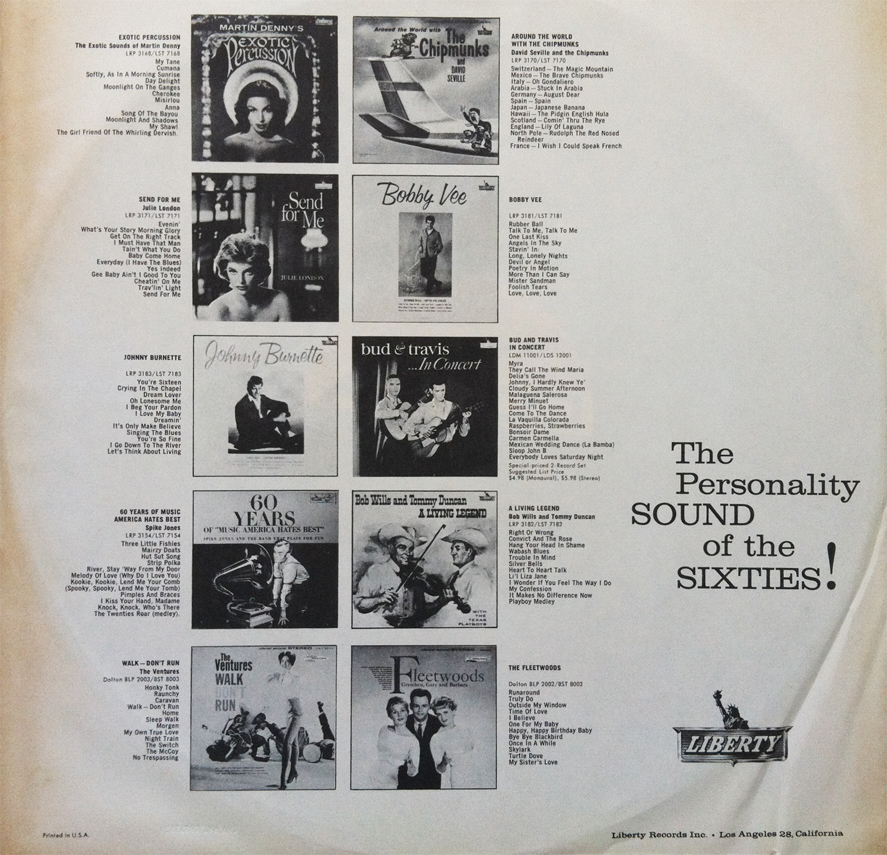
Sound of the SixtiesAccording to Liberty Records Inc. (Los Angeles 28, California), Martin Denny’s Exotic Percussion, Around the World With the Chipmunks, Bud and Travis in Concert, and 60 Years of Music America Hates Best are definitively, the personality sounds of the 1960s.

Forget about The Kinks, 13th Floor Elevators, Tim Hardin, Silver Apples, The Monks, Them, The Zombies, and the man in black… and for that matter, forget about the entire UK Encroachment (that’s what it’s called, right?), because Johnny Burnette, The Fleetwoods, and Bobby Vee are decade-defining personalities that history has proved to be as monumental as the title of this record label.

Liberty Records, like a symbolic statue of freedom, knew personality when they heard it. And thank goodness, because I don’t know what I’d do without ­all the tree-hugging, acid-dropping, tie-dyed skirt wearing, marvelous wonders provided by Bob Wills and Tommy Duncan.

Enjoy the Sound and Variety of Coral Records

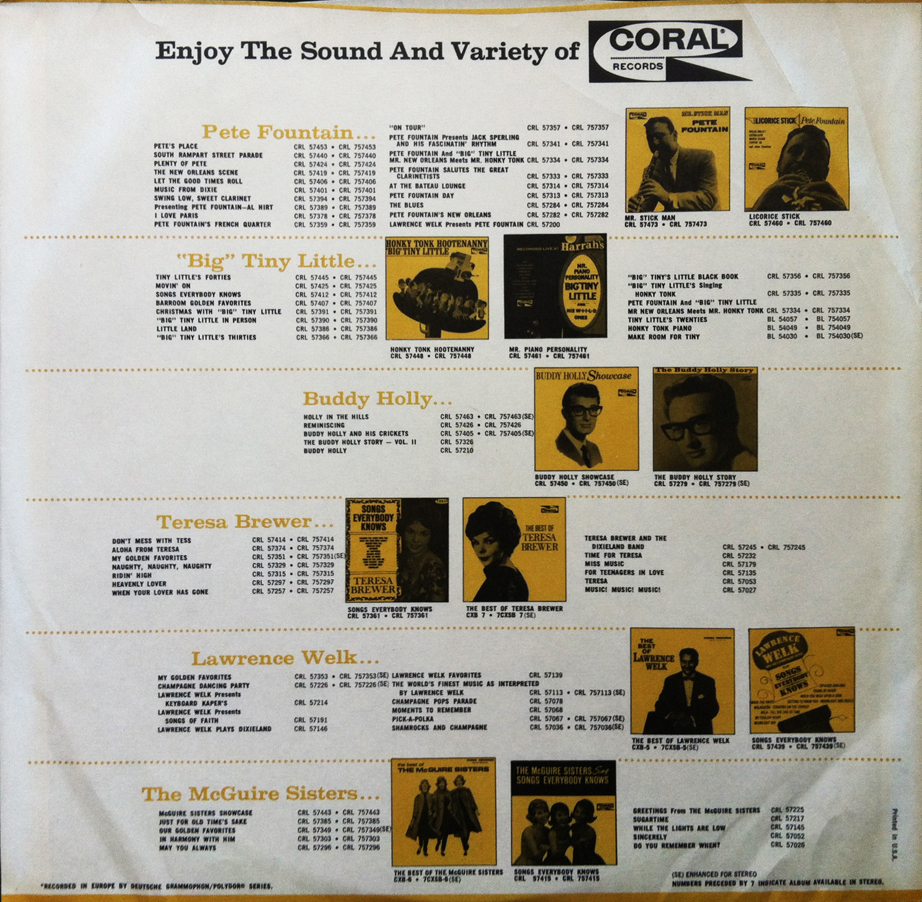
Coral Records InsertIn my attempt to corner the market of obscure, and rarely seen insert ads, my post-minded attention is shaken and gleefully captured by this two-tone insert by Coral Records.

Home to Buddy Holly and the Crickets, Coral Records was the not-so-ugly stepsister (subsidiary) of Decca Records. Formed in 1949, Coral Records saw fan-favorite releases by these, and many other big-name artists: Milton Berle, Lawrence Welk, Patsy Cline, Debbie Reynolds and the McGuire Sisters.

Coral Records LogoUnfortunately, Coral Records’ inspiring logo wasn’t enough to save the label’s merger with MCA Records in the 1960s. Save for the Lawrence Welk recordings, what was once known as a thriving and prolific label (they had Buddy Holly and the Crickets for crying out loud!) would devolve and become swallowed up by the Universal Music Group machine.

The phrase, “Buddy Holly Lives” may be true, but his label is now owned by a theme park.

ATCO Records (AKA The Stuff Atlantic Records Wants Nothing to Do With)

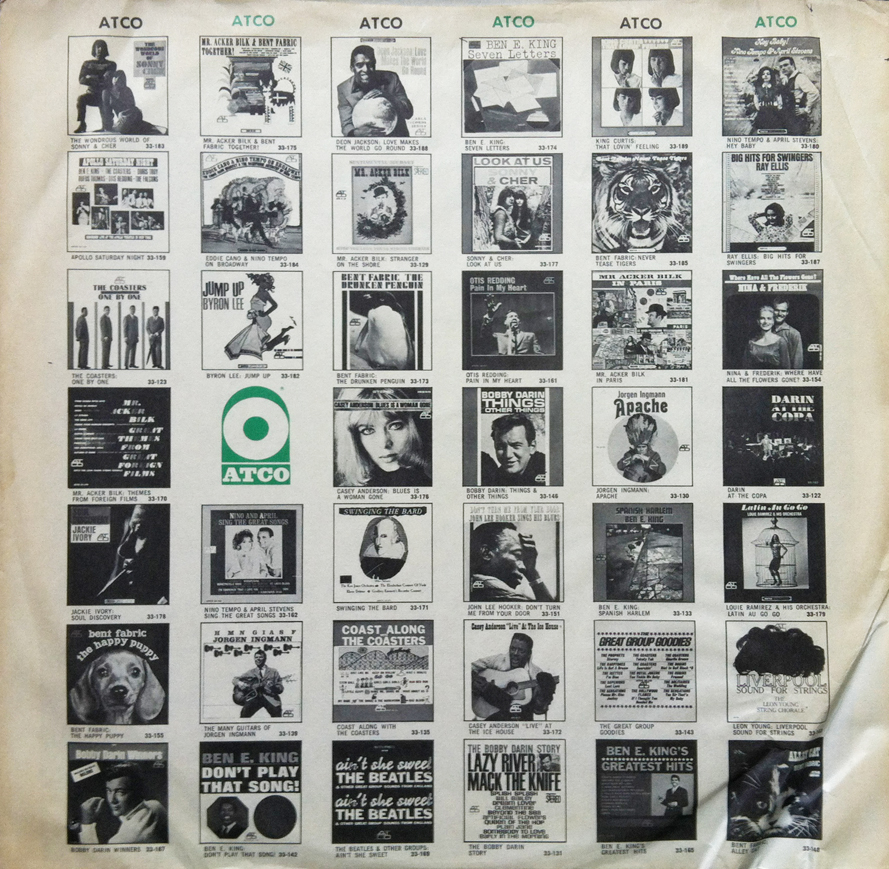
ATCONot only is Atco an unincorporated gaggle of pleasant homesteaders in Camden County, New Jersey, it’s also a record label and subsidiary of Atlantic Records Corporation (ATlantic COrporation… see what they did there?). Founded in 1955, ATCO served as an outlet for acts that, for one reason or another, didn’t fit the Atlantic Records format (Atlantic Records needs to lighten up if you ask me).

One of ATCO’s early releases is the 1964 compilation titled, Ain’t She Sweet. I don’t own this record… but I wish I did. It features The Beatles (with Tony Sheridan, recorded in 1961), and fetches a hefty $600 on Discogs. Keep an eye out for this one in the $1 bins.

What I dig most about these old inserts, apart from the frequent reminder of how to care for my records, is the variety of new bands I otherwise wouldn’t have heard of. Now, I’ve heard of Bent Fabric (Bent Fabricius-Bjerre), but I didn’t realize that most of his covers featured animals. My favorite from this insert is undoubtedly, The Drunken Penguin. That, coupled with Alley Cat, The Happy Puppy, and Never Tease Tigers just became the top four records in my want list.

Thanks to the nice people of Atco, and ATCO for the groovy suggestions.

New from RCA Victor Circa:1958

Enjoy1958 was a riveting year for RCA Victor Records, and this (Moon juiced) insert proves that the late 50s were a swinging, boisterous time for the 2nd oldest recording company in the United States. This prolific insert promotes everything from Frank Sinatra & Tommy Dorsey, to Perry Como, to the twins… you know the twins, Jim and John Cunningham (apparently Teenagers Love the Twins… who knew?), to the King, Elvis Presley, to a personal favorite, Glenn Miller, and finally to a little album called, My Favorite Hits, which is simply described as, “Mickey Mantle picks his favorites.” This last little number just made my Discogs Wantlist.

It’s enthralling to write about (barely touch upon) 1958 while listening to 1987’s Love an Adventure by Pseudo Echo, but things need to be kept into perspective, am I right?

In conclusion, here’s a little Thursday, mid-morning (or Friday, early morning in Australia) mind-melting math for you to digest:

     Love an Adventure: 1987 – (minus) My Favorite Hits: 1958 = 29 year gap

     Present Day: 2013 – (minus) Love an Adventure: 1987 = 26 year gap

If you’re like me, and you remember the Funkytown residing Pseudo Echo, than you, my friend, are old… you’re welcome.

When Fan Clubs Were a Thing

Fan ClubFollowing up on yesterday’s EFO (Electric Fawcett Orchestra) post is… wait for it… the reverse side to that advert. I bet you didn’t see that coming.

Remember when Fan Clubs were a thing? Neither do I, but apparently, there was enough of a buzz going around the many successes of this Orchestra of Electric Light, that they felt an inherent need to cash in on these mouth-watering fans by offering exclusivity by means of an ELO Fan Club.

For only $5 ($18.68 by today’s means), you would receive the following unique and fashionable ELO swag:

– An autographed poster. This is an EXCLUSIVE OFFER, people! This point is made abundantly clear by EXCLUSIVE OFFER being typed in all caps. Also, as if you needed clarification, this is only available to Appreciation Society Members (a fancy term for Fan Club geeks).

– Nine color photos of the band (offered in various sizes… including wallet sized, because, you never want to be caught without six photos of your favorite Birmingham Symphonic rock band).

– An official Appreciation Society Membership Card (personalized and embossed) entitling you to special offers for belt buckles and other icons of late 70s fashion.

– A personal bio of each band member (so you could launch your career as a celebrity stalker).

– An Official Appreciation Society Membership Certificate… are you ready? “Suitable for framing.” Because, you know, that faded picture from your wedding day has been hogging the wall-space for a bit too long.

– And a “beautiful” folder. When I think of beauty, my mind immediately goes to a cardboard folder with an ELO logo on it. Doesn’t everyone?

The crazy thing, is that I’d probably join the Electric Light Orchestra Appreciation Society.  Now the hunt for an ELO belt buckle begins…

1977 Called, and They Would Like to Sell You This T-Shirt

ShirtsAre you an ELO fan? I’m sorry… of course you are. Then why not parade your adulation for Rock-and-Classical-fused-future-pop by ordering one of these exquisite Electric Light Orchestra t-shirts? They come form-fitted and ready to rock your next Saturday night Farrah Fawcett marathon (don’t be coy, we all do it), and will guarantee more than a few waves of enamored attention from a certain special someone you’ve had your ensorcelled eyes on.

Found wedged in my copy of the unconsciously hypnotizing Out of the Blue double LP (you know, the one with Turn to Stone and Mr. Blue Sky on it), this mind-blowing insert begs for the yearning of an era just a few short years before I was born… an era of Farrah Fawcett hair, suggestive smiles, and sensationally groovy licks.

New “Bite” to the Brass

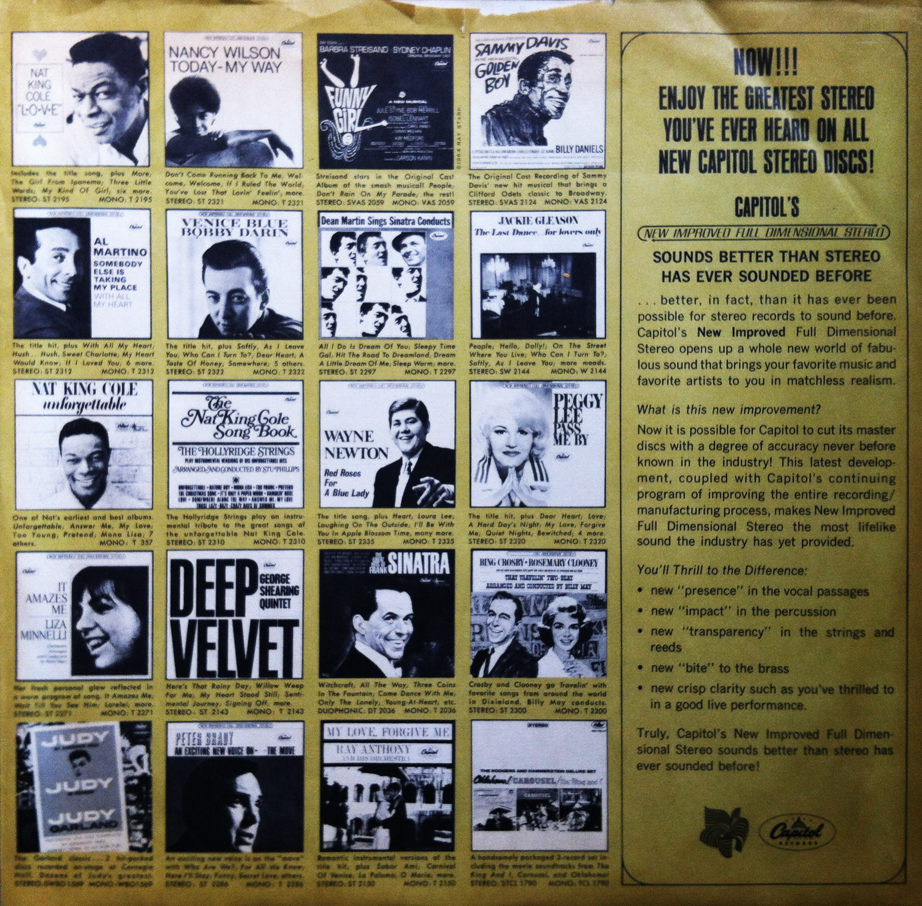
New BiteCapitol Records has done it again! They’ve taken the everyday, and turned it into the distant, inexcusable past. When posed with the question, How much more stereo can you get? Capitol Records answered with, New Improved Full Dimensional Stereo, fool!

New Improved Full Dimensional Stereo is revolutionary it its approach to releases offered by Capitol Records. By offering new “presence” in the vocal passages, new “impact” in the percussion, new “transparency” in the strings and reeds, and new “bite” to the brass, you’ll swear Liza Minnelli is actually belting out “her fresh personal glow” right before your watering eyes.

Capitol Records’ New Improved Full Dimensional Stereo… you’ll thrill to the difference.

If It’s a Hit… It’s on Smash Records

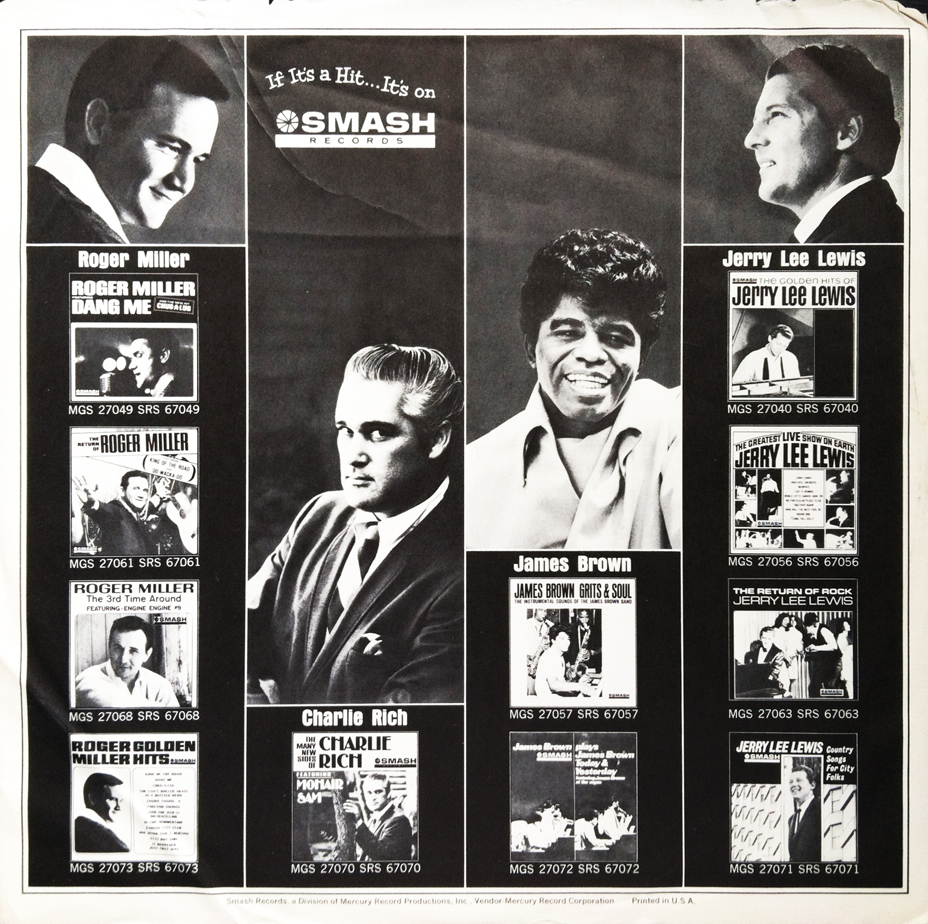
Smash RecordsIf it’s on any other label in the monumental history of music recording, it’s a lemon. Smash Records is a bit full of themselves, don’t you think? Looking at their big guns, or at least the four featured artists on this insert (that was printed in the U.S.A., mind you), this bold claim, at first sight, seems justified, or at least viable. But, given that these are only four artists out of, oh, I don’t know, EVERY ARTIST OF EVERY COUNTRY OF EVERY GENRE OF EVERY GENERATION THROUGHOUT THE HISTORY OF MANKIND, the phrase, “if it’s a hit… it’s on Smash Records” can be read as a stiff middle finger response to “the rest” of the hitless noise polluting the ears of the music-loving public all across this giant rock.

Roger Miller, Charlie Rich, James Brown, and Jerry Lee Lewis were all fantastic artists… but if your entire music vocabulary consists of only Smash Records recordings, 1) you’ve got a lot of work to do and 2) your lack of music-listening happiness gathers no sympathy from me.

Smash Records… Everything else is just noise.

The Peak of Achievement in Recorded Sound!

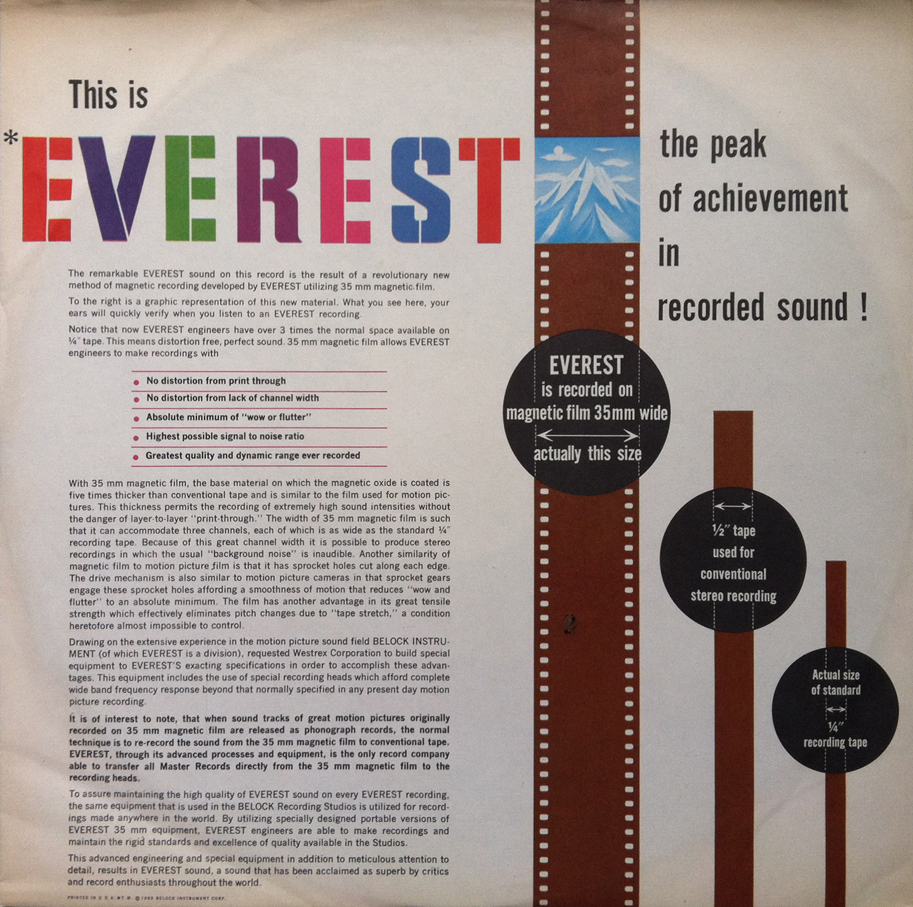
EverestThis is 1959, and size matters. Until the launch of “the remarkable Everest sound”, we’ve all been, collectively and obliviously, shortchanged when it comes to the quality of our audio recordings. You see, standard tape size for recording audio (that will later be transferred, then pressed into a platter spinning, groove disc) is ¼” or 6.35mm. Conventional stereo recording is ½” or 12.7mm (feel free to view the picture for tape scale). But Everest, with its 1) No distortion from print through, 2) No distortion from lack of channel width, 3) Absolute minimum of “wow or flutter”, 4) Highest possible signal to noise ratio, and 5) Greatest quality and dynamic range ever recorded, well tape stock used by Everest clocks in at a whopping 35mm! How you feeling now, standard and conventional stereo recording? Not so good, huh? Once you go thick, you’ll never get sick. Once you drop thin, you can’t help but grin. Or how about, once you go fat, you’ll never look back… I give up.

This is Everest… the peak of achievement in recorded sound!

The E Stands for Elektra

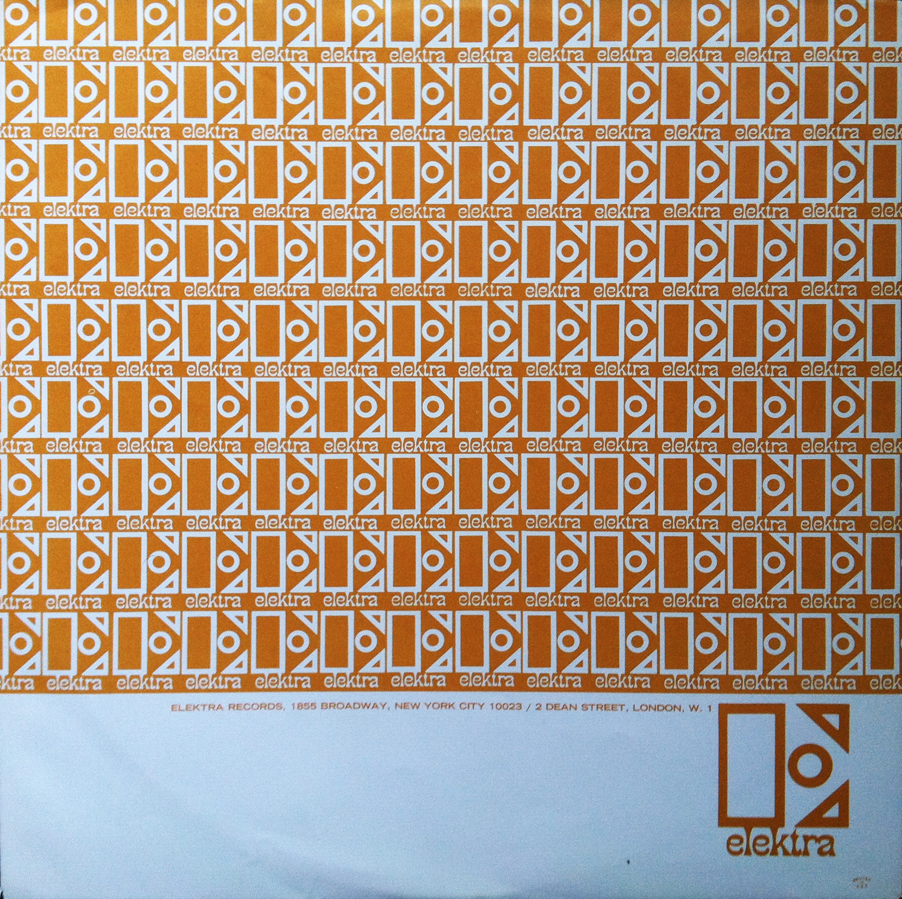
Elektra InsertOn exhibit today is another fantabulous record sleeve design. This pleasing little eye-catcher consisting of a simplistic, yet instantly recognizable repetition of logos (and essentially horizontal and vertical lines… for which I am a sucker) would make for great wallpaper (in your living room as well as your computer’s desktop).

Finding beautiful inserts like this has forced me to reevaluate my thrift store rummaging. Before, I’d skim through the often bruised and battered stack of LPs until something grabbed my eye. Now, I dedicate a little more time and check out all the timeless inserts. This, of course, takes some three to four times longer to hunt, but the rare find, such as this sleeve from Elektra, is well worth the further exploration.

Listening in Depth

Listening in DepthListening in Depth, as apposed to listening in width, I suppose, is Columbia’s new (at the time) marketing gimmick to sell their “360 High Fidelity” phonographs. “Choose from more than 35 new Columbia phonographs in a wide price range and variety of cabinet designs and colors.” The phonograph featured here, Model 532, is available in mahogany, blonde mahogany, dirty-blonde mahogany, sandy-blonde mahogany, unnatural-blonde mahogany, ditsy-blonde mahogany, or walnut.

Announced in this ad-sert is Columbia sound laboratory’s own Directed Electromotive Power, or D.E.P. for short. This new feature “seals the sound chamber for tonal balance throughout the entire listening range.” (Seals it with a kiss, I suppose.)

Considering a phonograph upgrade to your own private domicile? “We invite you to inspect these portables, consoles and combinations at your Columbia Phonograph showroom today.” Update: All former Columbia Phonograph showrooms have, rather unfortunately, been converted into Jo-Ann Fabrics stores, with the exception of Wisconsin. Those have been transformed into Ben Franklin discount stores.

Just in Case You Suffered A Swift Blow to the Head

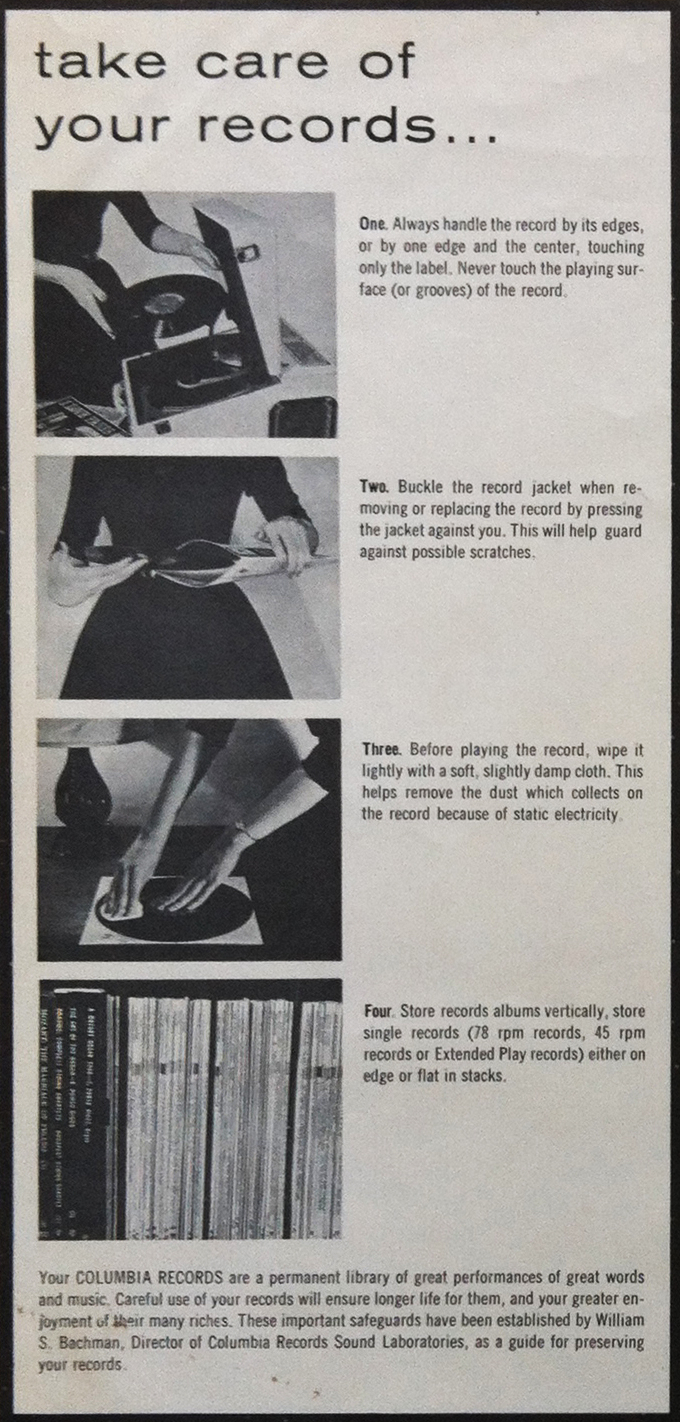
Take Care of Your RecordsBack by unpopular demand, and just in case you suffered a swift blow to the head, presented here, with all its painstakingly careful glory, is yet another “How to Take Care of Your Records if You’ve Never Owned Anything That You’d Like to Keep for More Than a Day.” This round… Columbia Records.

This is the third installment in mind-numbingly obvious, and exhaustively basic record care. First we heard from Mercury Records (Mercury Records Think You’re An Unmitigated Muttonhead), followed by RCA Victor (RCA Victor’s Simple Suggestions for Proper Record Care…). What sets Columbia Records a notch or two above the previously mentioned labels, when it comes to overtly apparent proper record usage, is the “live action” snapshots used to demonstrate each of the four (apparently) easy to forget steps to ensure proper record care. Mercury Records went with the casual, artist sketch look, while RCA Victor went with a more fiesta meets basic minimalist approach. It’s amusing to see how different labels tackle the same tedious (and did I mention obvious?) steps of proper record care. By the looks of these amazing stock footage shots, Columbia Records was doing well for themselves in 196?

By now you (should) know the dos and don’ts of proper record care, so I won’t waste your time by breaking it down for you. I will, however, waste your time by returning tomorrow with the third and final panel from this Columbia Records ad-sert. Here’s a little hint: It’s called Listening in Depth.

Columbia Records Reminds You to Take Care of Your Needle…

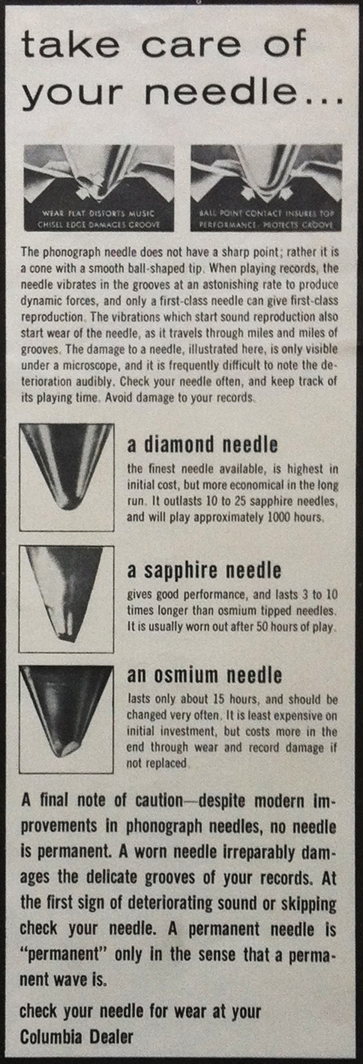
Take Care of Your Needle_smallerDo you own an animal? Perhaps a yippy dog that draws anger and vengeful hatred from your neighbors when it constantly yips all day and every night? Or maybe you own a furniture scratching cat, or a cannibal fish, or maybe even a pot-bellied pig whom you call “Breakfast.” If you’ve ever owned an animal, you know the inherent responsibility that tags along. Your hi-fi stereophonic home entertainment system is no different. Sure, it may not need blood worms twice a week, or it may not require you to scoop up its feces with a thin-layered bag from Ralph’s, and it may not even wake you up at 4am by sitting on your face, but your phonograph’s needle gives you years of listening pleasure, and like a money-sucking (but unquestionably worth it) house pet, it needs your care.

What I learned from this ad-sert (an advert crossed with an insert):

1) An osmium needles lasts only 15 hours. For those of you who enjoy the tedious trip to your overpriced phonograph dealer (and if you’re in LA you’d be required to brave the bumper-to-bumper to get there), then this is the needle for you. Nothing compliments a majestic, and borderline romantic dinner-date at home quiet like the phrase, “I’m sorry dear, I’ve got to head to George Meyer TV & Stereo for another osmium needle. Please put the meatloaf in the microwave, and when I get back we can finish this Burl Ives album.” 15 hours?! Are you kidding me? Why even bother making them? Why not have turntables that only last 24hrs? I struggle to see the logic.

2) Only a first-class needle can give first-class reproduction. Second, third, and even fourth-class needles don’t only cause breakage and ear-slapping skips on your favorite Hollies album, but they’ve also been known to short out the wall socket, fry your nice shag carpet, and even burn down your lovely (this is subjective, of course), and fashionably outdated bachelor pad. A wise man doesn’t fly Coach when it comes to purchasing a needle. Don’t be an unwise man.

3) Avoid damage to your records. You mean I SHOULDN’T use my Marlene Dietrich albums as serving ware at my poorly catered, and forcibly causal dinner parties? Gosh, maybe I should stop carving my initials into the grooves so as to mark my territory when I take my records to those rye and record parties. Perhaps I’ve been ignorant to the whole “take care of your records” thing.

Columbia Records is never one to miss the overbearing opportunity to point out the painfully obvious when it comes to basic, record-related audio care. Tomorrow, we’re going to focus on yet another elementary approach to securing the longevity of your music library, and once again, it comes courtesy of Columbia Records. Happy Monday, kids!

To Play and Play Again!

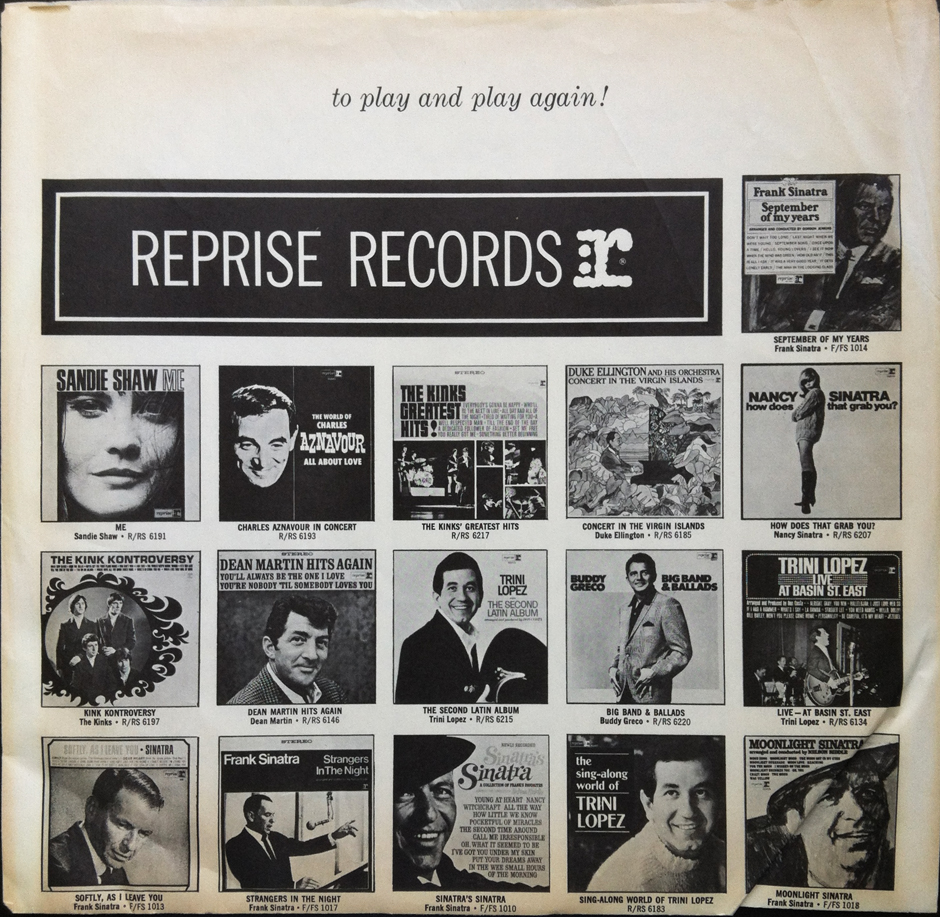
Reprise InsertQuick question… Q: What do The Kinks, Dean Martin, Duke Ellington, Frank Sinatra and Nancy Sinatra all have in common? A: Quite a bit actually; you’re going to need to be a bit more specific.

Fine, I’ll tell you. They were all monumentally talented artists on the Reprise Records label. As a longtime collector of the Kinks, I’m a bit surprised to find Duke Ellington and Dean Martin to be their egg-borrowing neighbors. Apparently Reprise was started by Frank Sinatra in 1960, and then sold to Warner Bros. Records in 1963… and a year later the label would land the rights to Pye Records (UK label of the Kinks), and the well-rounded and eclectic Reprise Records family was born.

This is an insert from Frank Sinatra’s Strangers in the Night album. Not being a huge fan of the womanizing crooner, I decided to avert my attention to the brothers Davies. Have a good Saturday!

A Ménage à trois of Stereo Sound

Motorola 3 FrontThis 10” demo record sleeve was tucked inside a random Goodwill find, and from 1959, advertises a new, three amp phonograph from Motorola… yes, THAT Motorola.

My best guess is that this record was either offered to phonograph dealers when these new, Motorola 3 Amplifier Stereophonic High Fidelity phonographs were released, or it accompanied the unit upon its purchase. Either way, this was a 10-track compilation record containing handpicked material that best showcased these 3 amplifier units.

Motorola 3 BackA quick Google search reveals a vintage advert from 1960, featuring two of these (extremely expensive) 3 amp units. The SK28 model goes for a whopping $329.95 ($2522.93 adjusted for inflation) where as the smaller model retailed for $299.95 ($2293.54 adjusted for inflation). Lucky for the folks of the late 50s, early 60s, this particular advert offers a payment plan, starting with $10 down ($76.46 adjusted for inflation). Something seems WAY out of whack here, but I don’t have time to give it any more thought.

I never owned the record that this sleeve swore to protect, but it’s nice to see Motorola’s logo hasn’t changed in the past 54 years.